
Ever found yourself at a 3 Card Brag table, unsure if your hand is worth a bold bet or better off folded? You are not alone. Understanding the hand rankings makes decisions quicker and more confident.
This guide lays out the hands from strongest to weakest, explains how ties are settled and compares a few common questions players ask. Read on to see which hands to admire and which to treat cautiously.
Understanding the Basics: What Is 3 Card Brag?
3 Card Brag is a traditional British card game played with three cards per player from a standard 52-card deck. Each player looks at three face-down cards and chooses whether to bet, raise or fold based on the strength of that hand. Once betting ends, remaining hands are revealed and compared to determine the winner.
Because only three cards are used, the game moves quickly and the relative rarity of each combination has a big impact on its rank. Before we list the hands in order, it helps to know that the rarer a combination is, the higher it tends to sit in the hierarchy. The next section explains every category with clear examples so you can recognise them at a glance.
Ranking System Explained: From Best to Worst Hands
Hands are ordered by how unlikely they are to appear and by conventional rules specific to 3 Card Brag. Below are the categories with examples and concise notes about where they sit in the hierarchy.
Prial: The Highest Possible Hand
A prial, short for pair royal, is three cards of the same rank, for example three kings or three aces. In 3 Card Brag the prial of threes is treated as the highest possible prial, so three 3s outrank other prials. This exceptional ranking reflects the game's long-established traditions and makes that specific combination uniquely powerful.
Prials are very rare, which is why they occupy the top position in the ranking order. Because of their rarity and status, they will beat all other hand types in a standard showdown.
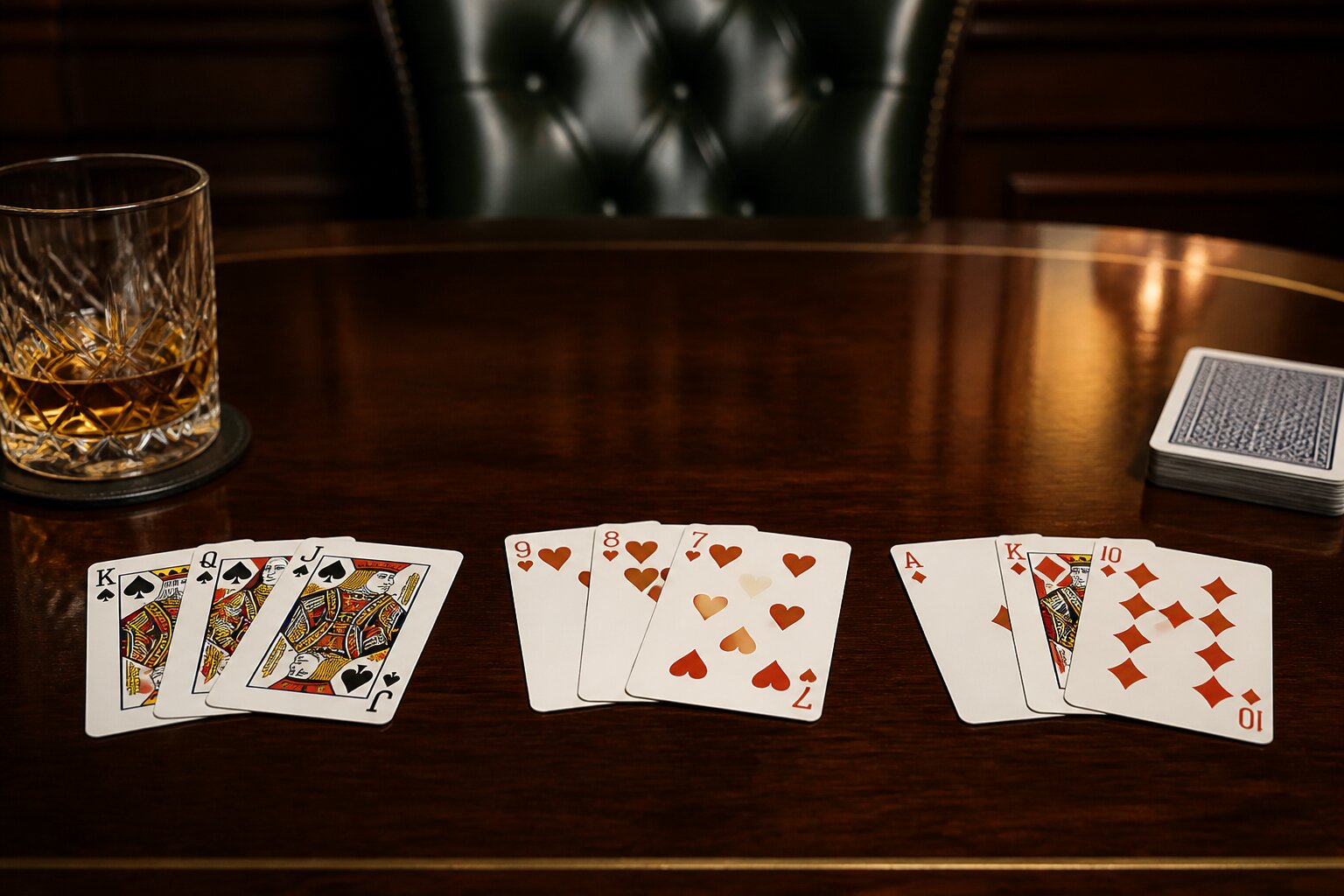
Example: 3♣ 3♦ 3♠
Running Flush
A running flush, sometimes called a straight flush, is three consecutive cards of the same suit. It ranks below a prial but above all other sequences or suits because it combines both sequence and suit. The combination of sequence and matching suit makes a running flush considerably less likely than a plain run or flush.
Players often value running flushes highly because they are both visually distinct and statistically uncommon, giving them strong chances in direct comparisons with most other hands.
Example: 4♠ 5♠ 6♠
Run
A run, or straight, is three consecutive cards not all of the same suit. It is more common than a running flush but stronger than a flush because the sequence alone has higher rank here. Runs can be formed from any suits as long as the cards follow in sequence, so they appear more frequently than running flushes but still beat any non-sequential hand.
When comparing runs of equal sequence, usual tie-breaking rules apply based on the highest card in the run.
Example: 7♣ 8♠ 9♥
Flush
A flush is three cards of the same suit that are not in sequence. While sharing a suit makes these hands noticeable, they rank below runs because they lack the sequential element. Flushes can vary in strength depending on the high cards within them, so two flushes are compared by their highest cards if they face each other.
Because suits do not have intrinsic ranking in most casual games, comparisons between same-suit flushes rely on card ranks rather than suit order.
Example: 2♥ 6♥ 10♥
Pair
A pair is two cards of the same rank plus one unrelated card. Pairs are easier to obtain than most of the hands above them, so they sit in the middle of the ranking order. When two players both hold pairs, the higher pair wins; if pairs are equal, the unrelated kicker card decides the outcome.
Pairs provide a balance between frequency and value, often serving as a practical hand to play when higher combinations are unlikely.
Example: K♦ K♠ 7♣
High Card: The Lowest Option
When three cards do not form any of the categories above, the hand is judged as a high card. The player with the single highest card wins if no better combination is present. High-card hands are the most common and least powerful.
If two players both have high-card hands, the comparison proceeds by the highest card, then the next highest, and so on, until a difference is found. High cards are often used as a fallback when drawing or betting on stronger hands is not an option.
Example: Q♣ 9♠ 5♦
With those categories clear, the next section explains how ties are handled when two players hold hands in the same group.
How Do Ties Work in 3 Card Brag?
Ties are uncommon but straightforward to resolve. When two players hold hands in the same category, the values inside that category are compared.
For prials the higher ranking triple wins, except for the special case where a prial of threes ranks above all others. For runs, running flushes and flushes the hand with the highest top card takes precedence. For example, a run of 9-10-J beats a run of 6-7-8 regardless of suits. If hands are identical in both value and suit, which is extremely unlikely with a single deck, the pot is split equally.
Suits are not used to break ties in standard 3 Card Brag rules, so comparisons focus on card values and order to keep the result clear and consistent. The following section answers a few specific questions players often ask about these rankings.
What is the strongest possible hand in 3 Card Brag?
The strongest hand is a prial of threes, meaning three 3s. This unique ranking places that combination above all other prials and every other hand type. It is a special rule in classic 3 Card Brag that gives the three threes a singular status, so if you are ever dealt this hand you hold the highest possible combination.
Because the deck contains only one of each card, a prial of threes is extremely rare. That rarity is part of why it is so prized at the table, and why players often remember it as the single best outcome in the game.
How does a straight compare to a flush in 3 Card Brag?
A run, or straight, ranks higher than a flush in 3 Card Brag. Even if a flush might seem visually stronger because of matching suits, the sequence in a run carries more weight in this game. For instance, 5♣ 6♦ 7♠ will beat 2♥ 6♥ 9♥.
Runs are judged by their highest card when comparing two otherwise equal sequences, so a higher ending card wins. Suits do not have an intrinsic ranking in standard Brag, so two flushes of different suits are compared by their card values rather than by suit.
Can you have a straight flush in 3 Card Brag?
Yes. That is the running flush: three consecutive cards all of the same suit. It ranks below a prial but above both runs and flushes because it combines sequence and suit. A running flush is therefore a very strong hand and will usually win unless it meets the exceptional prial of threes.
What happens with exactly matching hands is addressed above, but it is worth remembering that true identical hands are rare with a single deck and are handled by splitting the pot. When two players do have hands of equal rank and equal value, the usual procedure is to share the stakes, ensuring a fair settlement without favouring one player over another.
Are the hand rankings the same as three card poker?
No. The order differs in key ways. For example, in 3 Card Brag a prial can outrank a running flush, whereas in some poker variants the straight flush is superior. These differences matter when assessing your hand at the table.
Familiarising yourself with the specific ranking order used in the game you are playing helps avoid confusion during play. With these rules in mind, you should be able to recognise where your hand sits in the order and understand how ties are settled. Play within the rules and with clear expectations, and the game becomes easier to enjoy and follow.
Play Online Casino Games at Free Spins No Deposit Casino
We welcome you to our site, where you can relax and enjoy a friendly, straightforward experience from the start. Our team is here to make sure you feel at home while exploring what we offer.
Getting set up couldn’t be easier—simply create your account, make your first deposit, and you’re all set to dive in. We look forward to seeing you around and hope you have a great time with us.
**The information provided in this blog is intended for educational purposes and should not be construed as betting advice or a guarantee of success. Always gamble responsibly.