
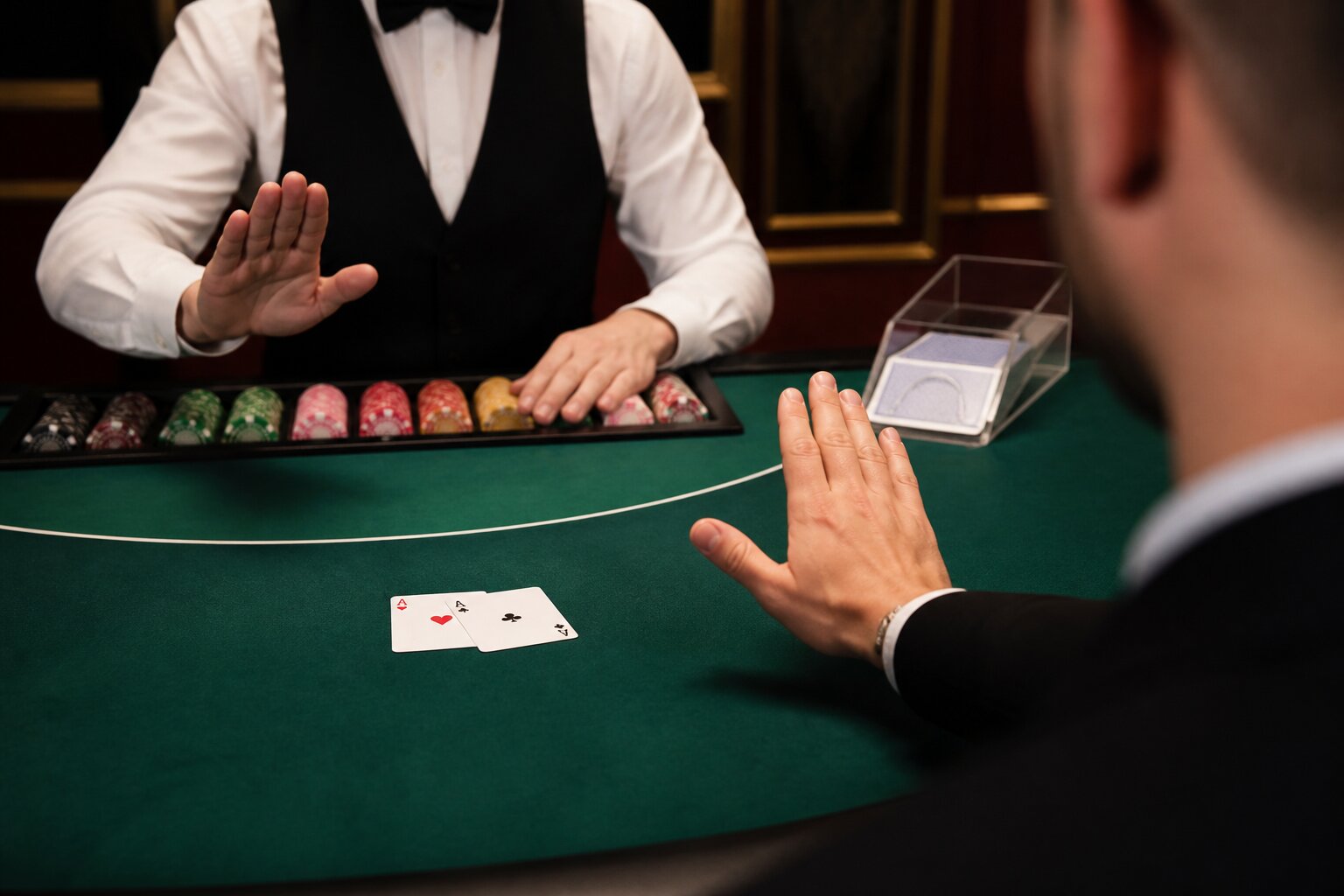
Walking up to a blackjack table for the first time can feel a bit daunting. It’s fast-paced and everyone seems to know exactly what to do — right down to those little hand movements.
If you’ve ever wondered what those taps, waves or card slides mean, you’re not alone. Using the correct hand signals keeps the game clear and prevents misunderstandings at the table.
Ready to feel more confident at the table? This guide covers the core signals, common mistakes to avoid and how dealers respond, so your next visit runs smoothly and with minimal fuss.
What Are Blackjack Hand Signals?
Blackjack hand signals are the clear, visible gestures players use to tell the dealer which action they want taken with their cards. Instead of relying on speech, each decision — like taking another card or standing pat — is shown with a standard movement so the dealer and surveillance cameras can record the choice unambiguously.
These gestures are part of the table rules in land-based casinos and are used whether cards are dealt face up or face down. They protect players and staff by creating a clear record of intent: when an action is shown properly, there is no question about what the player asked for. The next section explains why that clarity matters in practice.
Why Are Hand Signals Important at the Blackjack Table?
Hand signals keep play flowing and reduce disputes. When every action is visible, the dealer can react quickly, staff can verify transactions and security footage captures a straightforward record. This matters most when the casino is busy or there’s background noise that would otherwise make hearing a spoken request difficult.
Using correct signals also supports fairness and accountability. Because gestures are standardised, everyone at the table understands what’s being requested without confusion. That clarity protects you if a question arises about how a hand was played, and it helps the dealer apply the rules consistently. Understanding the basic gestures makes it easier to follow the game and avoids hold-ups — and the next section describes those gestures in detail.
Essential Blackjack Table Gestures Explained
Each common action at a blackjack table has a recognised, simple gesture to match it. To request another card, a player taps the table gently beside their cards; this visible tap signals “hit.” To show “stand,” a small wave of the hand, palm down, over the cards tells the dealer no more cards are wanted.
For “double down,” the usual custom is to place an additional chip beside the original bet and then point with one finger at the cards, indicating a single forthcoming card. To “split” a pair, place an equal bet next to the original and indicate the two cards — commonly with a V shape using two fingers or by pointing at both cards. In games where cards are dealt face down, sliding cards slightly under your bet signals a request for another card, while tucking them under chips indicates a stand.
These gestures are short, visible and designed to avoid ambiguity so the dealer can act without asking for clarification. Understanding them makes the rest of the table’s actions easier to follow.
Recognising Dealer and Player Actions
Knowing what both players and the dealer will do helps you keep pace with the table. Players use the signals above to indicate hits, stands, splits, doubles and, where allowed, surrender. Each of those player choices prompts a precise dealer response: dealing another card for a hit, moving on for a stand, separating and resolving each hand on a split, placing a single card after a double down, or collecting half the stake on a surrender.
Dealers operate under strict procedures so every action is handled the same way for every player. That consistency keeps play predictable and fair, and it also helps surveillance and pit staff to verify hands when needed. With those routines in mind, the next section looks at how bets and cards are positioned to keep communication clear.
How to Signal Your Intentions with Chips and Cards
Chips and cards form part of the visual language at the table. Always place your chips clearly in the betting area before the deal and avoid touching them once cards are in play except where rules allow — for example, adding chips to split or double down bets. When increasing a bet for a split or double, place the extra chips beside the original wager so the dealer can see the amount at a glance.
If the game requires players to handle their own cards, keep them above the table and visible at all times. Use the standard gestures rather than moving or removing cards from the playing area. These small habits reduce confusion and make it straightforward for the dealer and camera operators to record each decision accurately. The following section contrasts how these physical cues compare with online play.
Blackjack Hand Signals in Land-Based vs. Online Casinos
In land-based casinos, physical gestures and chip placement are the means of communication; they rely on visible movement and dealer attention. In online blackjack, the interface replaces those gestures: players click or tap labelled buttons such as “Hit” or “Stand,” and the software logs the decision instantly.
Because the mechanism differs, etiquette also shifts. Online play focuses on understanding the interface and timing your clicks, while casino play emphasises clear, visible actions and neat chip placement. Both formats depend on rules and predictable procedures to keep gameplay transparent, but the way intentions are conveyed reflects the environment you’re in. Next, consider the common mistakes newcomers make so you can avoid them.
Common Mistakes Players Make with Hand Signals
New players often hesitate or mix gestures, which creates uncertainty for the dealer and can slow the game. Examples include tapping too softly when requesting a card, waving in a way that looks ambiguous, or placing extra chips on top of existing stacks instead of beside them when doubling or splitting.
Another frequent issue is touching bets after the cards are dealt or moving cards away from the playing area, actions that can raise security concerns and invite extra checks from staff. Speaking instead of signalling can also lead to missed instructions if the dealer does not hear you or if cameras cannot clearly record the request.
Being decisive, keeping chips and cards visible, and using the approved gestures helps the dealer process actions quickly and keeps play moving. With that reassurance in place, the next section dispels some common myths about signals and etiquette.
Myths About Hand Signals and Table Etiquette
There are a few persistent misunderstandings about hand signals. One is that the wrong gesture can affect the cards dealt; in truth, gestures only communicate decisions — they do not influence card distribution. Another myth is that etiquette is merely ceremonial; in fact, it’s part of the table’s operating rules and helps protect all participants.
Stories about secret signals or signals that give an advantage are also unfounded: the gestures in use are standard and publicly explained at tables. Finally, politeness won’t change how dealers follow the rules; trained staff apply the same procedures to everyone to ensure consistent treatment. The next section offers tips to help your actions at the table be clear and confident.
Tips for Clear and Confident Communication at the Table
Clear communication starts with learning the gestures and using them decisively so the dealer and cameras can see your choice. Keep your hands, chips and any permitted cards above the table and within view, and place extra chips beside your original bet when increasing a stake for split or double options.
Observe the dealer’s rhythm and avoid interrupting while they are dealing. If unsure about a local variation of a rule, watching a round first or asking for the house rules before sitting down will help you participate without slowing play. Calm, visible gestures and tidy chip placement make your intentions easy to record and help the table run smoothly. To answer some practical concerns, the final section addresses frequently asked questions.
Do I have to use hand signals, or can I just say what I want to do?
Hand signals are the official method of communication in UK land-based casinos because they provide a clear visual record of each decision. Spoken requests are acceptable for clarity or politeness, but signals are the primary way actions are recorded by staff and cameras.
What if I make the wrong gesture by mistake?
If a gesture is made in error, notifying the dealer straight away allows them to verify and correct the action. Dealers are trained to confirm unclear signals before finalising play, so prompt clarification resolves most issues without disruption.
Can I touch my chips or cards at any time?
Chips should be placed in the betting area before a hand begins and only handled again as permitted, for example when matching bets for a split or double. Cards should remain visible on the table and only be touched if house rules allow; avoiding unnecessary contact reduces security checks and keeps play clear.
Is blackjack etiquette different in online casinos?
Yes. Online play uses buttons and on-screen prompts rather than physical gestures, and timing and interface familiarisation become the focus. Despite the medium, following the platform’s rules and being clear about actions still supports transparent gameplay.
Are there penalties for breaking hand signal rules?
Breaches of table protocol can cause delays and may lead to warnings. Repeated disregard for rules can result in removal from the table to protect fairness for other players. Most issues are resolved quickly when players correct their behaviour and follow the dealer’s instructions.
Following the simple practices above will make your time at the blackjack table more straightforward and enjoyable; learn the gestures, be decisive in your signals and keep chips and cards clearly placed so the dealer can act without hesitation.
**The information provided in this blog is intended for educational purposes and should not be construed as betting advice or a guarantee of success. Always gamble responsibly.