
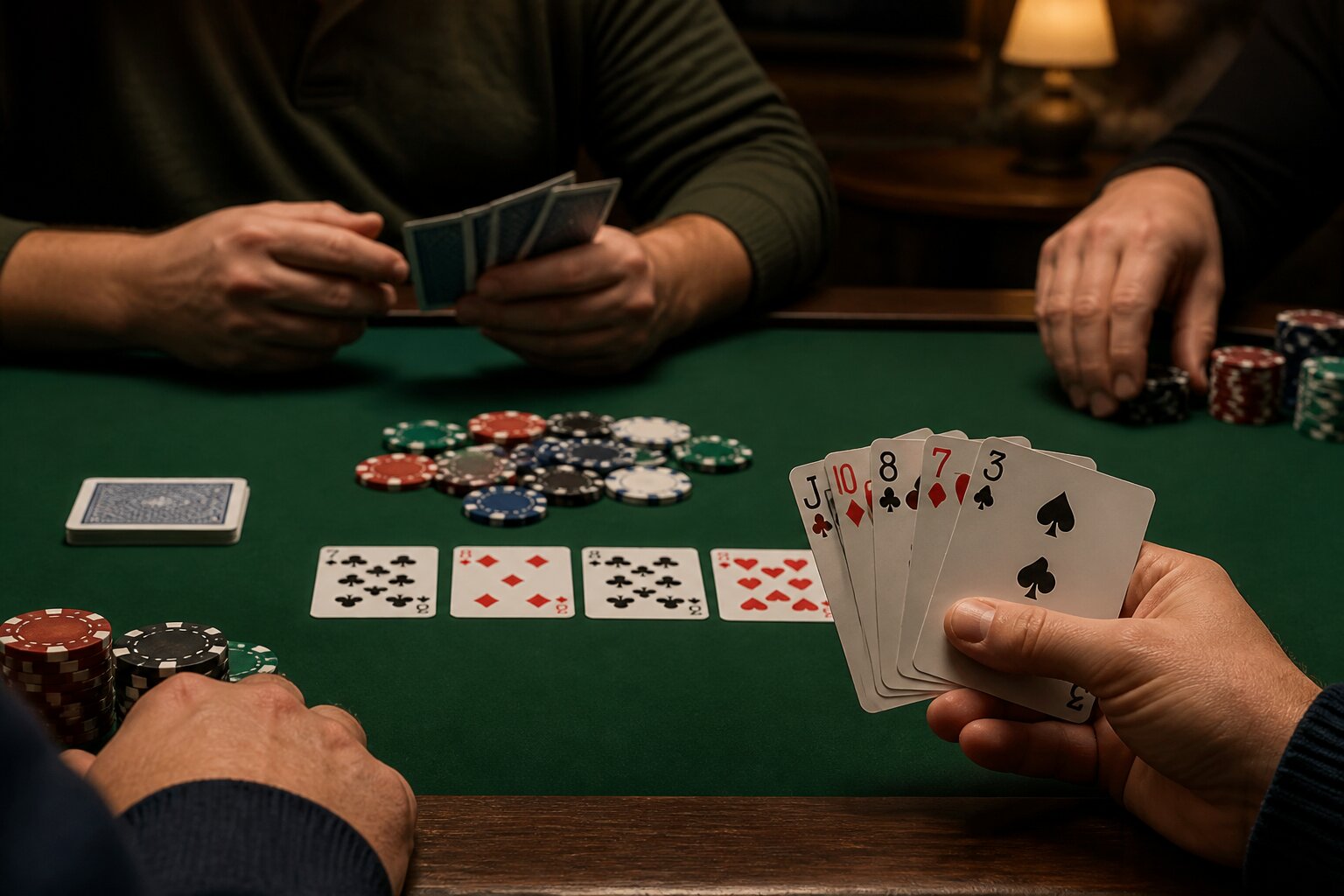
Ever fancy a poker game that changes every round? HORSE poker mixes five different poker variants, testing a range of skills across Hold’em, Omaha Hi-Lo, Razz, Seven Card Stud and Stud Eight or Better.
If the variety feels daunting, you’re in the right place. This guide walks through what HORSE is, how the rounds work, the card values you need to know and the specific rules for each variant — all written so you can pick things up quickly and join in with confidence.
Ready to get started? Let’s dive into what makes HORSE distinctive and how the game flows from one round to the next.
What Is HORSE Poker?
HORSE is a mixed game format that rotates through five established poker variants in a fixed order. Each letter in HORSE stands for one of those games: Hold’em, Omaha Hi-Lo, Razz, Seven Card Stud and Stud Eight or Better. The rotation forces players to adapt continuously, rewarding versatility rather than mastery of a single format.
The switch between games happens either after a set number of hands or once a scheduled time period ends, depending on the table rules. That constant change is why players need a working knowledge of each variant — and why the game appeals to those who enjoy variety and strategy.
HORSE is played by adults only; in the UK that means 18 and over, and games should be hosted by operators who meet regulatory standards.
How Do You Play HORSE Poker?
A HORSE session follows the same basic flow each time: the table plays the current variant under its usual rules and betting structure, then moves on to the next game in the rotation. In many venues HORSE is offered in a limit format, where bets and raises use fixed amounts, which keeps action predictable and easier to follow.
When your seat is called, post the required blinds or antes and play according to the specific rules of the variant showing. Dealers or platform interfaces will indicate the active game so everyone knows what to expect. If you’re new to a particular round, observe how other players handle betting and hand selection — experience is the quickest way to become comfortable with each format.
A little preparation before you sit down — a quick review of hand rankings and the distinct requirements of games like Omaha or Razz — will make the rotation feel much smoother.
Key Rules for Each Game in HORSE Poker
Each variant in HORSE has its own structure and objectives, so it helps to think of them as separate games that happen to be played back to back.
Texas Hold’em Rules
In Hold’em, each player receives two private cards. Five community cards are dealt face up in stages, and players construct the best five-card hand using any mix of hole cards and community cards. Betting occurs in four rounds known as pre-flop, flop, turn and river, with players adjusting their strategy as more community cards appear.
Omaha Hi Rules
Omaha Hi gives each player four hole cards and uses the same five community cards concept as Hold’em. The key difference is that a valid hand must combine exactly two of your hole cards with three community cards. That requirement changes starting-hand values and post-flop decisions, since many more card combinations are possible.
Razz Rules
Razz is a lowball variant where the objective is to make the lowest possible five-card hand. Players receive seven cards in total, some face up and some face down, and aces are always low. Straights and flushes don’t count against you, so a hand such as A-2-3-4-5 is the best possible. The exposed cards on the table influence betting and help you judge opponents’ chances.
Seven Card Stud Rules
In Seven Card Stud, there are no community cards. Each player is dealt seven cards across the hand, a mix of face-up and face-down, and must make their best five-card hand. Betting takes place across multiple rounds as more cards are revealed, and attention to opponents’ upcards plays a major role in decision-making.
Eight or Better (Stud Hi-Lo) Rules
Stud Eight or Better follows the same dealing pattern as Seven Card Stud, but the pot can be split between the highest hand and the lowest qualifying hand. To qualify as a low, five cards must be ranked eight or lower and have no pairs. If no qualifying low exists, the high hand wins the entire pot. This split-pot structure introduces different betting dynamics and encourages a wider range of starting hands.
Each of these summaries gives you the practical essentials you need for play; the differences between high and low objectives, the role of exposed cards and the exact card-use rules (for example, Omaha’s requirement to use two hole cards) are the details that change strategy from round to round.
How Do HORSE Poker Rounds Work?
The rotation in HORSE moves in a fixed order through the five variants; most tables will either repeat the sequence every few hands or switch when a clock or dealer rotation calls for it. Because many HORSE games run in limit format, the betting intervals are standardised, which keeps the pace steady even as the rules change.
When a game change is announced, players mentally switch their priorities — starting-hand requirements in Omaha are different from Hold’em, and the importance of exposed cards in Stud differs from community-card strategy. Observing other players’ adjustments is often as instructive as studying the rulebook.
Understanding the rotation and the common betting structures helps you remain composed and make better decisions when the game changes.
What Are the Card Values in HORSE Poker?
Card values vary by which variant is in play. In the high-hand games — Hold’em, Omaha Hi, Seven Card Stud and the high side of Stud Eight or Better — standard rankings apply, with aces able to act high in most situations and low only when forming specific straights like A-2-3-4-5.
By contrast, Razz and the low side of Stud Eight or Better value low cards above all. In those rounds, pairs hurt your hand and the ace is always low; a five-card sequence such as A-2-3-4-5 is the strongest possible low. Knowing whether a round awards the high hand, low hand or both is central to choosing which cards to play and how to bet.
Because the same physical cards can have different strategic value depending on the variant, quick mental shifts between rounds are a large part of what makes HORSE challenging and interesting.
HORSE Poker: Common Myths Explained
Mixed games like HORSE attract a few persistent misconceptions. One is that the format is only for highly experienced players. In reality, while the game rewards broad knowledge, many players build competence progressively by focusing on one variant at a time and observing others during rotations.
Another myth is that some variants dominate the outcome. Each round contributes equally to the session’s results; what changes is how you allocate attention and chips based on what is being played. Finally, success in HORSE is about adapting strategy to the active rules rather than relying on simple memorisation of exposed cards — sound judgment and familiarity with hand rankings are more valuable than rote recall.
These clarifications should make the mixed-game concept feel more approachable and less mystifying.
Essential Terms to Know in HORSE Poker
A short vocabulary helps when the game shifts quickly between variants. Here are the common terms that come up most often in HORSE play:
- Mixed game: a format rotating between different poker variants.
- Limit: fixed bet and raise amounts used in many HORSE games.
- Blinds: forced bets posted before cards are dealt, typical in Hold’em and Omaha.
- Ante: a small contribution all players make to the pot, common in Stud.
- Community cards: face-up cards on the table shared by all players in Hold’em and Omaha.
- Hole cards: private cards dealt face down to each player.
- High/low split: when a pot is divided between the highest and lowest qualifying hands.
- Rotation: the sequence in which the poker variants are played.
Familiarity with these terms helps you follow announcements and understand opponents’ behaviour as the table moves through each variant.
Where Can You Play HORSE Poker in the UK?
If you want to try HORSE online, choose platforms that are properly licensed and regulated within the UK. Licensed operators must meet regulatory standards that include consumer protection and fair-play checks, which helps ensure a safer environment for play.
Many poker sites offer mixed-game lobbies or scheduled HORSE tournaments in both cash and tournament formats. When choosing where to play, check that the operator displays a valid licence and provides clear information about table stakes, bet limits and game formats. Setting personal limits before you play and using available account controls are sensible ways to keep your sessions manageable.
Give a few different venues a quick look to compare game availability and schedule times that fit your plans; with the right setting, HORSE can be an engaging way to broaden your poker skills.
Final note: if you’re trying HORSE for the first time, start at lower stakes while you learn the rotation and the differing strategies each variant requires — that will keep the focus on skill development and enjoyment.
**The information provided in this blog is intended for educational purposes and should not be construed as betting advice or a guarantee of success. Always gamble responsibly.