
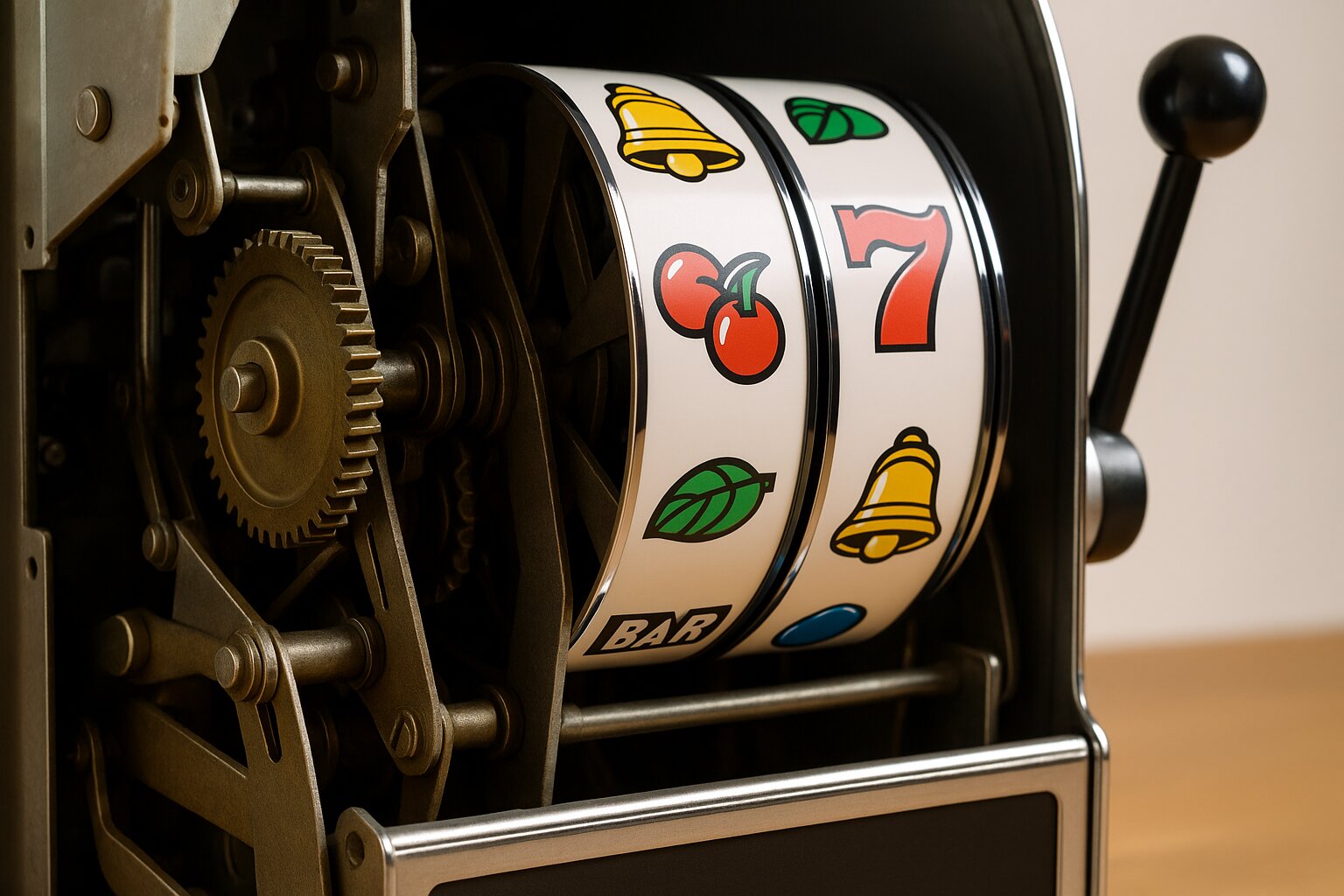
Ever found yourself fascinated by the spinning reels of a classic slot machine? You are not alone. Mechanical slot machines have been a staple in gambling venues for generations, drawing attention with their moving parts, sounds and the moment those reels come to a stop.
In this guide I will walk you through the real nuts and bolts behind these iconic machines — how they function, where the payouts come from, and what happens behind the scenes each time you pull that lever. Keep in mind that playing should be treated as entertainment; each spin is governed by random processes and cannot be predicted or controlled.
Ready to discover what really happens when those reels start to move? Let us take a closer look.
The Evolution Of Mechanical Slot Machines
Mechanical slot machines first appeared in the late 1800s and quickly became common in pubs and casinos. Early designs were simple: three spinning reels operated by a single handle that set the mechanism in motion.
Over the decades the machines evolved. Sturdier frames, more symbols on the reels and basic electrical additions appeared by the mid-20th century, improving reliability and payout delivery. In the 1970s a larger change arrived as electronic systems and microchips began to replace purely mechanical elements, laying the groundwork for the digital slots that followed.
Though mostly superseded by electronic machines, the old-style mechanical slots remain important historically. They show how gameplay relied on physical design and set payouts rather than software, and they help explain why modern machines base outcomes on tested random processes.
What Are The Main Components Of A Mechanical Slot Machine?
Mechanical slot machines may look complicated, but they are built from a few key parts working together every time you play.
These are the main components and what they do:
- Reels: Spinning cylinders with symbols printed on them. Classic machines usually have three reels.
- Handle: The lever that sets the reels in motion and initiates a game round.
- Payout mechanism: The internal system that releases coins or tokens when a winning combination appears.
- Hopper: The storage container that holds coins or tokens available for payout.
- Coin slot: The opening where money or tokens are inserted; some machines also use credit buttons.
- Internal gears and springs: Hidden parts that control how the reels spin and where they stop.
Each part is designed to work together so that the machine operates reliably and delivers outcomes that are random by design.
How Do The Reels And Payout Mechanism Operate?
Inside a traditional mechanical slot machine, several mechanisms combine to produce the game you see on the outside. When the handle is pulled, a sequence of gears and springs is set into motion. That initial force engages the reels and determines how long they spin.
Gears regulate the speed and duration of a spin, while springs and detents interact with ratchets to bring each reel to rest at a specific position. The stopping positions are determined by the machine’s design so that each spin is mechanically independent. Players cannot influence these internal movements through timing or technique.
If the symbols that come to rest form a winning combination, the payout mechanism activates. A set of linkages releases coins from the hopper, counting out the correct amount for that specific combination. The whole process is automatic and follows the preset paytable built into the machine.
This mechanical design emphasises consistent, random outcomes rather than any element of player control.
The Role Of Levers, Springs, And Gears
The handle’s motion transmits force through a series of gears until locking and release components free the reels to rotate. Springs return parts to their ready positions and help control deceleration so the reels stop cleanly. The interaction of these elements ensures spins feel smooth while remaining unpredictable in result.
When a reel stops, a pawl engages a notch that secures the reel. That notch corresponds to a symbol position on the reel strip. Because the location and frequency of symbols are fixed, the chances of particular combinations are determined by how those symbols are arranged on the reels.
How Are Payouts Calculated On Mechanical Slot Machines?
Payouts on mechanical machines are determined by fixed mathematical rules and the arrangement of symbols. Each reel carries a finite number of symbol positions, and the probability of a combination depends on how many times each symbol appears.
Machines display a paytable showing the reward for every winning combination. For example, three cherries might pay a small amount while three bar symbols pay more. Payout values are fixed and tied to the number of matched symbols shown by the reels.
Because symbol distribution controls probability, rare symbols that occupy few positions yield larger payouts when they line up. These probabilities do not change from spin to spin; each spin is an independent event based on the machine’s physical symbol layout.
This structure made payout behaviours transparent in mechanical machines: the paytable and the reel strips determined the odds and the rewards.
Understanding The Paytable & Coin Hopper
The paytable is the machine’s guide to what each combination pays. It is usually printed on the front of the machine so players can see which outcomes correspond to which prizes.
Once a winning combination is registered, the coin hopper carries out the payout. The hopper holds coins or tokens and is connected to the payout mechanism, which dispenses the correct amount automatically. Servicing staff refill the hopper as needed so the machine can continue to pay wins without interruption.
Combined, the paytable and hopper describe both the possible rewards and the practical means by which those rewards are delivered. They are key to understanding how outcomes translate into payments on a mechanical slot.
Are Mechanical Slot Machines Truly Random?
Mechanical slot machines are designed so that each spin produces an outcome independent of the last. The stopping positions are governed by mechanical interactions between gears, springs and the reel notches, which makes the result unpredictable from the outside.
Fairness depended on rigorous design and regular testing. Machines were assembled so that symbols had fixed frequencies on the reels, and inspections ensured nothing altered that arrangement. In that way, randomness came from the physical properties of the mechanism rather than from human input or patterns in play.
Because each outcome is separate, past spins do not influence future results. That principle underpins why mechanical slots were regarded as games of chance and why they required maintenance and oversight to preserve fairness.
Common Myths About Mechanical Slot Machines
There are a few persistent misconceptions about how mechanical slots operate. Addressing these helps set reasonable expectations about what the machines can and cannot do.
Myth 1: “Hot” or “Cold” Machines
Some players believe a machine can be “hot” or “cold.” In mechanical terms this does not apply. Each spin is an independent event determined by the positions of symbols on the reels and the machine’s internal stopping mechanism, so there is no continuous cycle between paying and non-paying states that a player can detect or predict.
Perceptions of a run of wins or losses are usually the result of short-term variance and selective memory rather than any change in the machine’s behaviour. The apparent streaks are natural outcomes of randomised events, not evidence that a machine is more likely to pay out after a run of losses or wins.
Myth 2: Machines Are “Due” to Pay Out
Another common idea is that a machine is due to pay after a long run without wins. Because outcomes are separate events, a machine does not track how long it has been since a payout in a way that changes future probabilities.
Payout rates are determined by the machine’s design and settings, which reflect long-term mathematical expectations. Those settings do not create short-term guarantees, and a past series of outcomes does not alter the chance of a particular result on the next spin.
Myth 3: Timing or Skill Can Affect Results
It is also sometimes thought that the timing of a pull or a particular technique can influence the outcome. In mechanical machines the internal mechanisms control the spin and stop points, so player input beyond initiating the spin does not affect the result.
While players may develop habits that feel like technique, such actions do not change the mechanical or statistical behaviour of the machine. The outcome is determined by the machine’s internal processes, not by the player’s skill once the spin has begun.
Clearing up these myths helps keep expectations grounded in how the machines actually work. Understanding the mechanical and probabilistic nature of slots supports informed decisions and responsible play.
Mechanical Vs. Modern Digital Slot Machines: Key Differences
Both mechanical and digital machines aim to provide unpredictable game outcomes, but they do so using different technologies.
Mechanical slots rely on physical reels, levers and internal components. Outcomes are the result of moving parts and fixed symbol distributions. Payouts are delivered by mechanical hoppers tied to visible paytables.
Modern digital slots use software-based Random Number Generators and graphical displays. An RNG produces a result that the game then maps to displayed reel symbols or other visuals, and payouts are handled electronically. Digital machines are subject to stringent testing and certification to ensure the RNG produces fair, statistically random outcomes; regulatory bodies verify these processes, including standards set by the UK Gambling Commission.
Both approaches focus on fairness and compliance, but mechanical machines offer a tangible, physical method of producing random outcomes while digital machines use tested software systems.
Safety And Maintenance Of Mechanical Slot Machines
Maintaining mechanical machines is important for player safety and for preserving game integrity. Regular work keeps machines operating as intended and prevents faults that could affect payouts.
Qualified technicians inspect components such as gears, springs and electrical parts to identify wear that might alter performance. Routine cleaning removes dust and debris from internal parts so reels and payout systems move smoothly. Where necessary, worn components are replaced to maintain original specifications.
Compliance checks by operators and external inspectors confirm that machines remain within regulatory requirements. Those checks focus on ensuring the paytable, reel strips and payout mechanisms are unchanged from their certified state.
These maintenance and safety practices protect players and help guarantee that outcomes remain the result of the machine’s designed mechanics rather than avoidable faults.
**The information provided in this blog is intended for educational purposes and should not be construed as betting advice or a guarantee of success. Always gamble responsibly.