
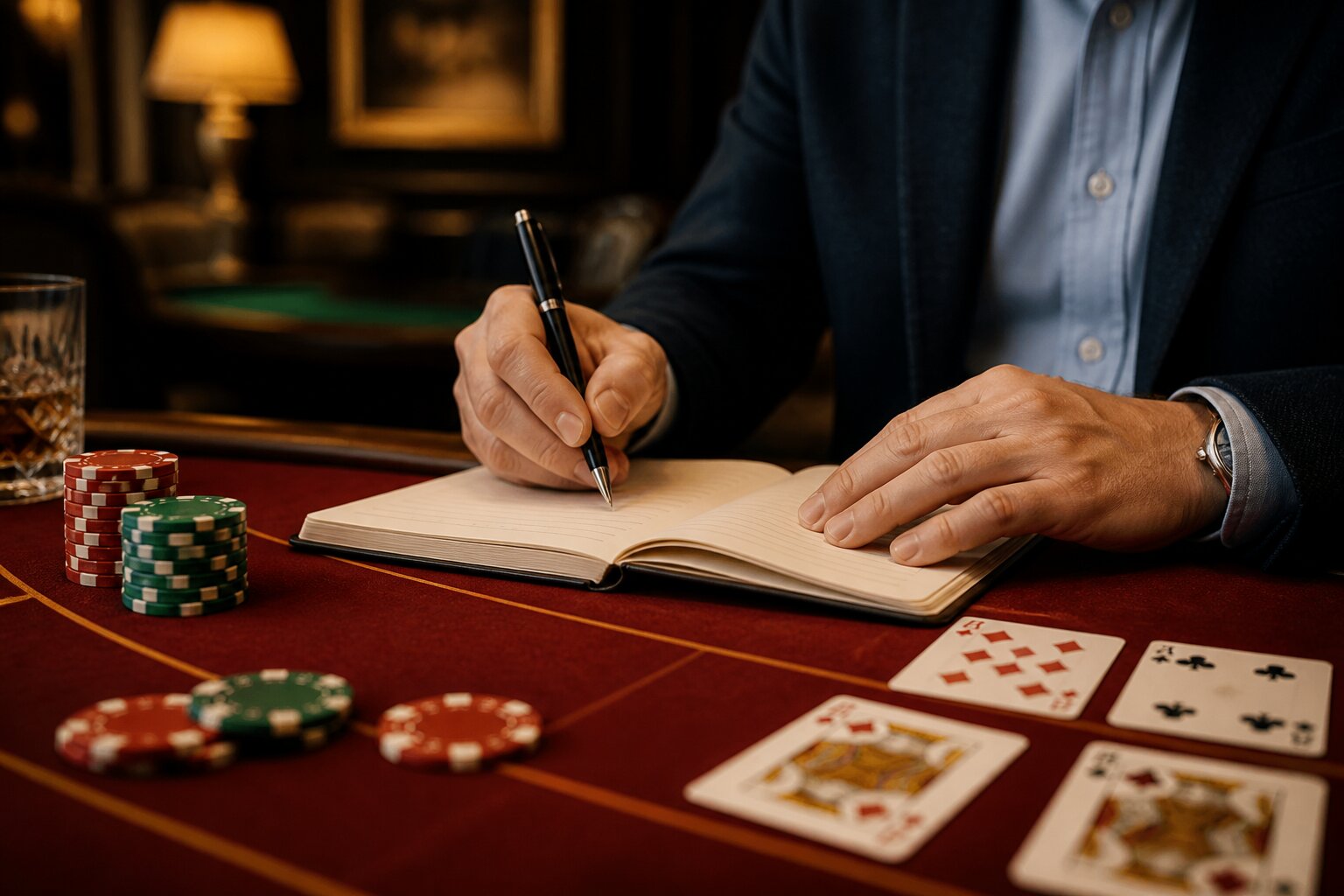
Ever wondered why so many baccarat players jot down numbers and scribble on tiny scorecards during a game? It isn’t just for show.
Keeping score in baccarat is a long-standing habit at tables and in online games. Some players find it helps them follow the flow, others enjoy the ritual. Whatever the reason, understanding scorekeeping sheds light on a social and analytical side of the game many newcomers don’t see.
Curious to find out what those charts really mean and why tracking results matters? Read on — we’ll explain the most common methods, the reasoning behind them, and what they actually do and don’t tell you.
What Is Scorekeeping in Baccarat?
Scorekeeping in baccarat means recording the outcome of each hand so you can see how results unfold over time. Players typically note whether the banker, the player, or a tie won each round, using a pen and paper or the digital charts provided in online play.
Historically, this began in brick-and-mortar casinos as a straightforward visual aid: a way to follow runs and switches without trying to memorise previous hands. Today the same ideas exist in digital form, but the purpose remains similar — to provide a record of recent results and a way to observe how the game is progressing.
It’s important to understand scorekeeping is a way to track what has happened, not to influence what will happen next. The value for most people lies in the information and enjoyment gained from monitoring the game’s pattern of outcomes.
How Do Players Typically Track Results in Baccarat?
Players use a few clear methods to record results. In physical casinos, pre-printed scorecards or plain paper are common; online, built-in charts automatically log every round. The typical process is to mark which side won each hand and place that mark into a grid or column that reflects the sequence of outcomes.
Some players use colours, letters or symbols to make reading the chart quicker. Others follow simple column rules — repeating an outcome goes down the column, a change moves to the next column to the right — which makes streaks and shifts easier to spot at a glance. Digital scoreboards do the same job without the need for manual note-taking, but the visual logic behind them is the same.
The practical benefit is not in changing odds, but in creating a clear record you can refer to while deciding whether you want to continue playing, change your wagering approach, or simply enjoy the unfolding pattern.
Why Do Some Players Believe in Keeping Score?
Many players keep score because it helps them structure what would otherwise be a continuous stream of separate outcomes. Seeing results laid out visually can make the session feel more analytical and engaging.
For others, the scorecard is a social or psychological tool — it gives a focal point, a way to talk about the session with other players, or a method to test personal theories about game flow. That said, tracking won’t alter the mathematical fairness of the game: every hand is dealt independently, so past results don’t determine future ones.
Viewed as a pastime, scorekeeping can enhance interest and attention. Viewed as a predictive tool, it’s not reliable. Players who enjoy the activity should treat it as a personal preference rather than a route to better outcomes.
Common Methods Used for Baccarat Scorekeeping
There are several established ways to display past outcomes, each offering a slightly different perspective on the sequence of results. They are widely used because they simplify complex information into readable patterns and help players scan history quickly without implying any predictive advantage.
Bead Plate
The bead plate is a compact grid that records each hand from left to right, top to bottom. Players typically use coloured dots, letters or small symbols to represent whether the banker, player or a tie won each round.
Because it is linear and densely packed, the bead plate is useful for a quick historical record and for confirming the sequence of recent results at a glance. It is the simplest method for those who want a record without additional interpretation.
Big Road
The big road presents results on a larger grid and uses vertical continuity to show repeated outcomes. When the same result occurs consecutively, the marks move down the column; when the outcome changes, the marking shifts to the next column.
This layout makes runs and alternations straightforward to identify, making patterns of streaks easier to see than on a bead plate. It is commonly the starting point for the derived charts that follow.
Big Eye Boy, Small Road, and Cockroach Pig
These are derived charts that translate the big road into different symbols and spacing to highlight trends the original grid might obscure. They apply specific rules for symbol placement and for when to move to the next row or column.
They tend to appeal to players who enjoy decoding multiple representations of the same data and who want alternative visual perspectives. These derived roads emphasise pattern recognition rather than simple record-keeping and can make short-term regularities more apparent.
Each method organises past results in a visual way, but none can change the independent nature of each hand. Past outcomes do not alter the probability of future results.
Does Scorekeeping Impact the Outcome of Baccarat?
No. Scorekeeping does not affect what happens in the next hand. Cards are shuffled or, in digital play, results are produced by a random mechanism. Each round is an independent event, so a recorded sequence cannot alter or predict a future result.
The practical effect of keeping score is informational: it helps players see what has occurred and may inform choices about whether to keep playing or adjust stakes. It does not provide a mathematical advantage, and no tracking system has been shown to change expected returns.
If you keep a scorecard, treat it as a way to monitor the session and enjoy the game’s unfolding story rather than as a method to influence outcomes. Remember to set sensible limits and stay within your budget.
Are There Myths About Tracking Baccarat Results?
Yes — several persistent myths surround scorekeeping. A common one is that certain patterns make a particular outcome “due”. Another is that derived roads can reveal a system that reliably forecasts the next hand.
These ideas stem from how our brains look for order and meaning in sequences, especially when outcomes repeat. While the charts make patterns easy to spot, the appearance of a streak or alternation is simply a description of past events and does not change the independence of future rounds.
Approaching these myths with a clear understanding of what the charts show helps separate enjoyable habits from misleading beliefs. Treat scorekeeping as a record and a form of engagement, not a guaranteed strategy.
Should You Try Scorekeeping as a Beginner?
For a beginner, scorekeeping can be a harmless way to become more familiar with the game’s pace and terminology. It provides a clear record that can make following rounds less confusing and helps players learn what terms like “banker” and “player” mean in practice.
However, it’s not necessary for enjoying baccarat. Some new players find it distracting; others enjoy the additional layer of observation it offers. If you try it, focus on what enhances your experience. Keep the activity light and match it to how you like to play — whether that’s closely monitoring results or simply enjoying the moment.
If you find tracking detracts from your enjoyment, there’s no obligation to continue. The key is to use scorekeeping the way that best suits your own style and to maintain control over how long and how much you play.
Conclusion: The Role and Relevance of Scorekeeping in Baccarat
Scorekeeping is a long-standing part of baccarat that offers a way to record results, follow the flow of play, and engage more deeply with the session. It helps some players feel more involved and provides a clear visual history of recent hands, but it does not influence or predict future outcomes.
If you choose to keep score, treat it as a personal preference that adds to the experience rather than as a method for gaining an edge. Keep wagers sensible, set limits, and follow responsible gambling practices in line with regulatory guidance. Whether you take up a scorecard or prefer to watch without one, baccarat is best enjoyed when play stays controlled, informed and fun.
**The information provided in this blog is intended for educational purposes and should not be construed as betting advice or a guarantee of success. Always gamble responsibly.