
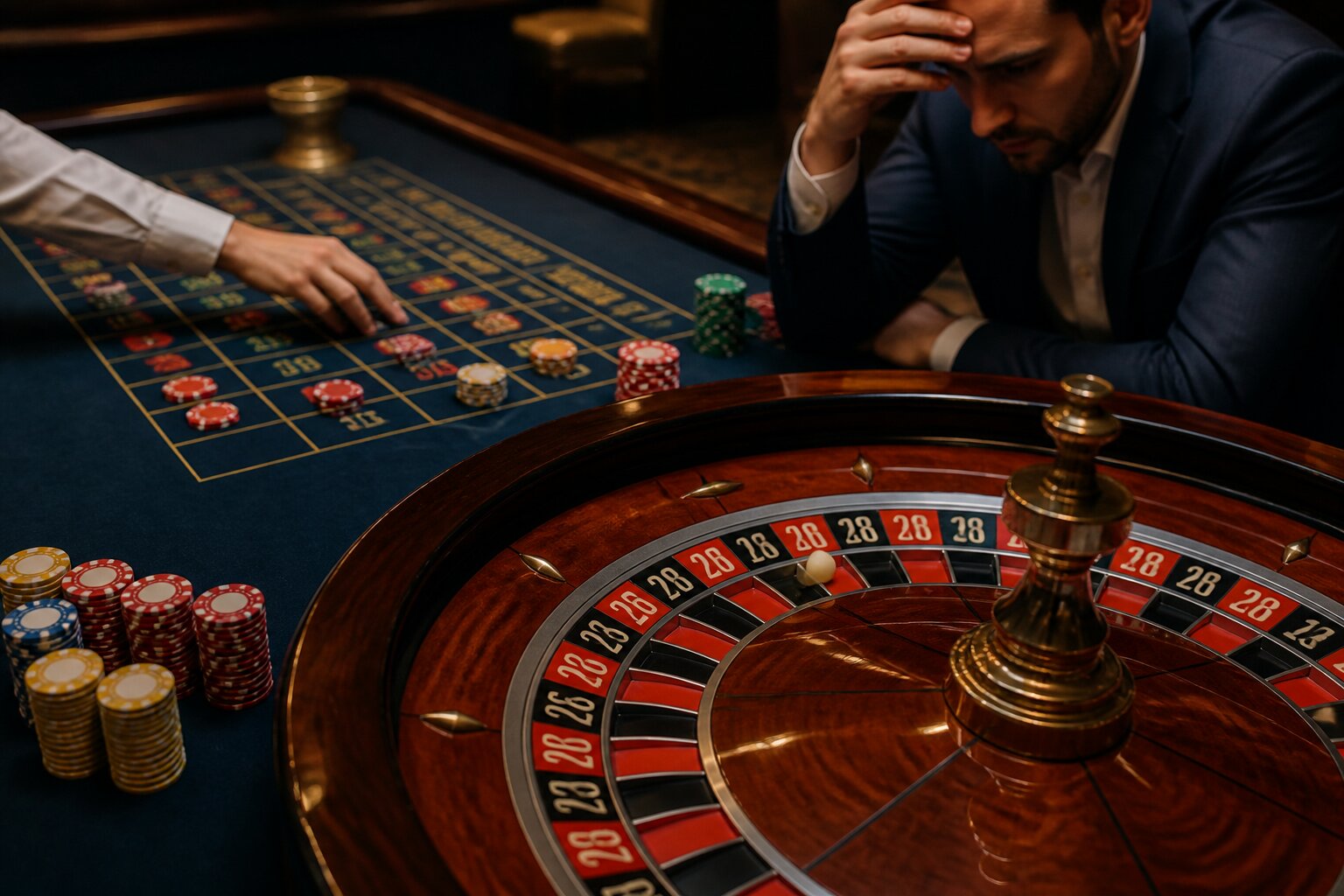
Ever found yourself watching the roulette wheel, spotting streaks of red or a run of odd numbers, and thinking you’ve cracked the code? You’re not alone. Many players notice sequences and start to look for meaning in them.
This article looks at the patterns people commonly report, uses real examples to show how those sequences appear, and explains why trying to predict future spins from past results does not work. Read on to learn what the patterns tell us — and what they do not.
Understanding Roulette: How Does the Game Actually Work?
Roulette is centred on a circular wheel with numbered pockets from 0 to 36. The numbers alternate red and black, with 0 coloured green. Players place bets on where the ball will land when the wheel stops. Bets can be narrow, such as a single number with a 35 to 1 payout, or broad, such as red or black, odd or even, which pay even money.
Every spin begins with a fresh, independent event: previous results do not affect the next outcome. That independence is fundamental to how the game works and is key to interpreting any patterns that appear.
Games in regulated venues and reputable online providers are subject to testing and regular checks to confirm that outcomes are properly random. With the mechanics and controls in place, the wheel or the software does not “remember” past spins, so apparent sequences arise from the nature of random sampling rather than from an underlying trend.
If you want to see how those apparent sequences show up in practice, the next section examines the kinds of patterns players tend to spot and why they look meaningful.
Can You Really Spot Patterns on the Roulette Wheel?
Players commonly notice runs such as several reds in succession, a string of odd numbers, or the same number repeating within a short span. These events can feel striking at the table and prompt betting changes in reaction.
Such streaks are a normal part of random play. Over hundreds of spins, clusters and repeats will appear simply because randomness produces variation. None of these observed sequences provide a reliable signal for what will come next; each spin remains independent of the ones before it.
Understanding that streaks are expected in a random sequence helps explain why trying to capitalise on them fails. To see how these general ideas map onto specific patterns people talk about, the following section breaks down the common types and what they really mean.
Commonly Observed Roulette Patterns Explained
Certain patterns grab attention more than others. Below are the types players most frequently point to, with clear examples of why they occur and what they imply.
Red/Black Runs: Are They Anything Special?
Long runs of red or black, such as red appearing six or more times in a row, feel exceptional but are an ordinary outcome in a long series of independent spins. The probability of red on any single spin remains the same regardless of previous results, so a current run does not increase or decrease the chance of a different colour next time. These clusters are a natural feature of random sequences and are not evidence of a change in odds.
This perspective leads into discussion of another frequently noticed phenomenon: the same number appearing multiple times.
Number Repeats and Hot Numbers: What Do They Mean?
Seeing the same number land two or three times in a short window can seem remarkable and gives rise to the “hot number” idea. In reality, every number has the same chance on each spin. Repeats occur by chance and do not make that number more likely on the following spin. Noticing a repeat is simply noticing part of the random distribution; it does not imply any predictability.
Next, some players suggest physical or software imperfections can skew outcomes, so the following section looks at those claims.
Sector and Wheel Bias Claims: Any Truth?
Claims that certain sectors, pockets or numbers occur more often because of a faulty or biased wheel have historical precedent, but they are rare in modern, regulated settings. Land-based equipment is maintained and checked, and online systems are subject to certification and audits. While a poorly kept wheel might theoretically produce a bias, in most contemporary environments the controls in place make such exploitable bias highly unlikely. That makes relying on supposed physical flaws an impractical strategy in typical play environments.
Having looked at common patterns and their explanations, the next section explores why prediction systems—psychological or technological—do not succeed.
Why Do Prediction Systems Fail in Roulette?
Many attempts to beat roulette are based on mistaken ideas about how probability and patterns work. Players often look for order in random sequences and expect short runs to balance out quickly. That expectation is misleading. Statistical properties such as the law of large numbers describe what happens over very long series of spins, not after a handful of outcomes. Mistaking short-term variation for a stable pattern is a common source of error.
Below are two central reasons systems tend to fail.
Gambler’s Fallacy: The Psychology of Patterns
A frequent error is to assume that a run of one outcome makes the opposite outcome more likely next. This is the Gambler’s Fallacy: the belief that past independent events change the probability of future ones. Because each spin is independent, the odds for a given outcome remain the same every time. People may perceive streaks as meaningful and become overconfident, increasing stake sizes or changing strategy in ways that raise risk.
Selective memory and confirmation bias make this worse. Players tend to notice and remember sequences that fit their expectations while forgetting those that do not. That distortion of perception can create the illusion that a system is working, even when results are consistent with chance. Recognising these cognitive traps is important for understanding why pattern-based approaches rarely succeed.
Turning to technology, some hope modern tools can overcome these limits, but they too run into fundamental barriers.
Are Computer Algorithms or Tools Effective?
Tools that analyse previous results or attempt to model the wheel cannot alter the built-in randomness of properly operated games. Certified random number generators in online play and audited procedures in venues are designed to prevent predictable patterns that could be exploited. In licensed casinos and regulated online sites the systems are checked to ensure outcomes meet statistical expectations, making reliable forecasting from short-term data effectively impossible.
Algorithms that claim predictive power either misunderstand independence in probability or rely on data from uncontrolled or non-standard equipment. In physical venues, genuinely biased wheels have occasionally been found historically, but modern maintenance and regulation make such mechanical predictability rare. Where data is taken from unregulated or poorly maintained equipment, it may reflect artefacts rather than genuine, repeatable edges.
In most real-world settings these tools do not provide a meaningful advantage and cannot reliably forecast outcomes. With that in mind, looking at actual result sets gives a clearer picture of how randomness looks in practice. Real-world data usually reinforces the expectation of independence and long-run variance rather than revealing exploitable short-term patterns.
What Do Real Roulette Results Show?
Real result sets demonstrate the same principles described above. Consider a sample of 100 spins that produced:
Red: 46
Black: 50
Green (0): 4
Within those totals, short streaks are visible: a run of seven reds, then a cluster of black spins, interspersed with greens. At the level of individual numbers, some will appear multiple times in a short stretch while others do not appear at all. Over larger sample sizes, the frequencies of individual numbers tend to move closer to their expected proportions, but short-term variation remains substantial.
These examples make clear that sequences, clusters and repeats are consistent with random outcomes. No reliable method exists to use such short-term patterns to predict future spins. With this understanding in place, it’s sensible to consider how to approach the game in a way that keeps play controlled and manageable.
How to Approach Roulette Responsibly
Roulette should be approached as entertainment rather than a means of earning money. Clear boundaries around time and money help maintain a healthy relationship with the game.
Deciding a budget in advance and using available tools to enforce it prevents spending beyond one’s means. Operators offer options such as deposit limits, session or loss limits, and time-outs; these help keep play within planned boundaries. If playing starts to feel problematic, longer-term self-exclusion and independent support services are available.
Because patterns and predictions do not change the underlying odds, treating roulette as an enjoyable activity with known limits keeps the focus on controlled play rather than chasing outcomes. Stick to predetermined limits, use the protective tools on offer, and step away if enjoyment is diminishing. That approach keeps roulette straightforward and under personal control.
Play Casino Games at Free Spins No Deposit Casino
At Free Spins No Deposit Casino, we’re proud to offer a welcoming place where you can enjoy a wide variety of casino games to suit every taste. There’s something for everyone in our lively community, whatever you’re in the mood for.
Getting started is easy—just create an account, make a deposit and you’re ready to explore our selection. We look forward to welcoming you.
**The information provided in this blog is intended for educational purposes and should not be construed as betting advice or a guarantee of success. Always gamble responsibly.