
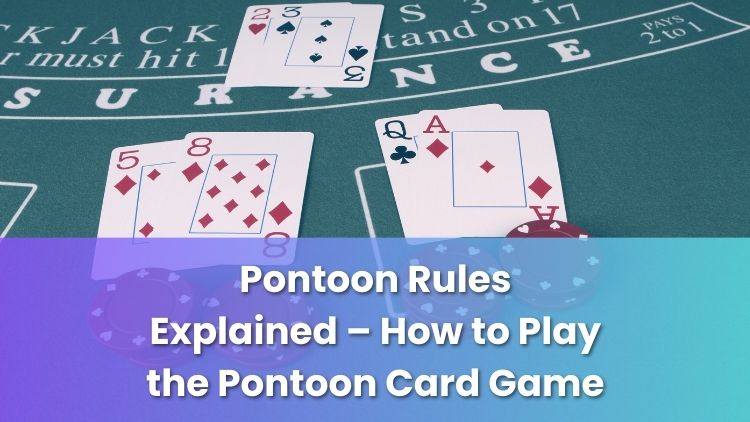
Pontoon is a classic British card game that’s closely related to blackjack, but it comes with its own twists and vocabulary. If you’ve ever found yourself confused by the difference between a “Pontoon” and a regular 21, or you’re not sure what a “buy” or a “twist” means, you’re not alone.
In this post, you’ll discover everything you need to get started, from the basic aim of the game to what to say and do during your turn. There’s no need for previous card game experience, just a bit of curiosity and perhaps a deck of cards to practise with if you fancy.
Whether you want to play for fun with friends or are simply keen to understand the rules used in UK games, you’re in the right place. Everything you need to know about how to set up, play, and follow the flow of the game is right ahead. Let’s start with what counts as a winning hand.
How Do You Win At Pontoon?
Winning at Pontoon is about getting a hand that beats the dealer without going over 21. The very best outcome is a “Pontoon,” which is an Ace with any 10-point card as your first two cards.
If no Pontoon appears, the next strongest result is a total of 21 with any number of cards. After that, hands are ranked by how close they are to 21 without exceeding it. Go over 21 and you go bust, which ends your round.
The dealer plays after all players have finished. If your total matches the dealer’s, the dealer takes the hand. So the aim each round is straightforward: build a strong total, stop before you bust, then see how it measures up against the dealer.
Pontoon Card Values And Hand Rankings
Each card has a set value. Number cards from 2 to 10 count as their number. The Jack, Queen and King each count as 10. The Ace can count as 1 or 11, whichever helps your hand. For example, Ace and 6 can be 7 or 17, changing to 7 if taking 11 would push you over 21.
The top hand is a “Pontoon,” made with an Ace and a 10-point card on your first two cards. Next best is a “Five Card Trick,” which is any five-card hand totalling 21 or less. A Five Card Trick beats every hand apart from a Pontoon, even a regular 21.
After those, a total of 21 is next in line, followed by any hand closer to 21 than the dealer’s. If you exceed 21 at any point, your hand is out for that round.
With values clear, the next question is how a round begins and how the betting fits in.
How Are Cards Dealt And Bets Placed?
Pontoon usually uses a standard 52-card deck without jokers. At the start of each round, every player places a bet within the table limits. Bets are decided before any cards are dealt.
The dealer then gives two face-down cards to each player and two to themselves, also face down. No one shows their cards at this point, which keeps every hand hidden and adds a bit of uncertainty to each decision.
Play continues around the table, one player at a time. When the initial deal is done, the first player chooses how to proceed and the round moves into the action.
What Are The Player Options During Play?
When it’s your turn, there are several moves you can make. Pontoon has its own terms for them, and once you’ve seen them in action, they are easy to follow.
Twist (Hit)
Ask for a “twist” to take another card. You can twist more than once, as long as your total does not exceed 21. The idea is to improve your hand without tipping it over the line.
Stick (Stand)
If you like your total, you “stick.” You keep the cards you have and take no more for that round. This is your way of saying your hand is strong enough as it stands.
Buy (Double)
To “buy” is to take exactly one extra card while adding an extra bet. The extra bet can match your original stake or be less, depending on house rules. After buying, you may still twist again if you want to, up to a maximum of five cards in your hand. Some tables limit when buying is allowed, so it is worth checking before you start.
Split Pairs
If your first two cards have the same value, you can split them into two separate hands by placing a second bet. You then play each hand in turn, with the same options to twist, stick or buy. Certain tables place extra limits on splits, especially with Aces, so rules can vary.
Now that the moves are clear, it helps to see how Pontoon compares with blackjack, which many players meet first.
What Is A Pontoon And How Does It Differ From Blackjack?
Pontoon is based on the same basic principles as blackjack, but uses different rules and language. Both games use standard decks and revolve around making a hand as close as possible to 21.
In Pontoon, the top hand is a “Pontoon,” an Ace with a 10-point card on the first two cards. Blackjack uses the same combination, but calls it a “blackjack.”
Another difference is how the dealer’s cards are handled. In blackjack, one dealer card is typically face up. In Pontoon, both dealer cards are face down until the end, so players make choices without seeing any dealer card.
The terms also change. Where blackjack uses “hit” and “stand,” Pontoon uses “twist” and “stick.” Options to place extra bets or split pairs can be broader in Pontoon, but the exact allowances depend on house rules. Pontoon is particularly common in the UK, both at home and in clubs.
Dealer Rules And Typical Payouts
When every player has acted, the dealer reveals their hand and plays to fixed rules. The dealer must twist on totals of 16 or less and must stick on 17 or more. If the dealer goes over 21, they bust and all remaining player hands win. If not, each player’s total is compared to the dealer’s.
Payouts follow a simple pattern. A Pontoon usually pays 2 to 1. A Five Card Trick also often pays 2 to 1. All other winning hands typically pay even money at 1 to 1. Exact payouts and any side conditions can differ by venue, so it is sensible to check the table rules before you play.
Which brings us to a detail that often surprises newcomers.
How Are Pushes Settled?
In Pontoon, a “push” is not a draw. As noted earlier, if your total matches the dealer’s, the dealer takes the hand. This applies to any matching total, including 21, so ties always favour the dealer.
This rule matters when choosing whether to twist, stick or buy. For example, if you are sitting on 18, matching a dealer 18 would still lose, so some players prefer to improve their total if the situation allows.
Play with clear limits in mind and take breaks when you need them. For advice and support, visit BeGambleAware.org.
**The information provided in this blog is intended for educational purposes and should not be construed as betting advice or a guarantee of success. Always gamble responsibly.