
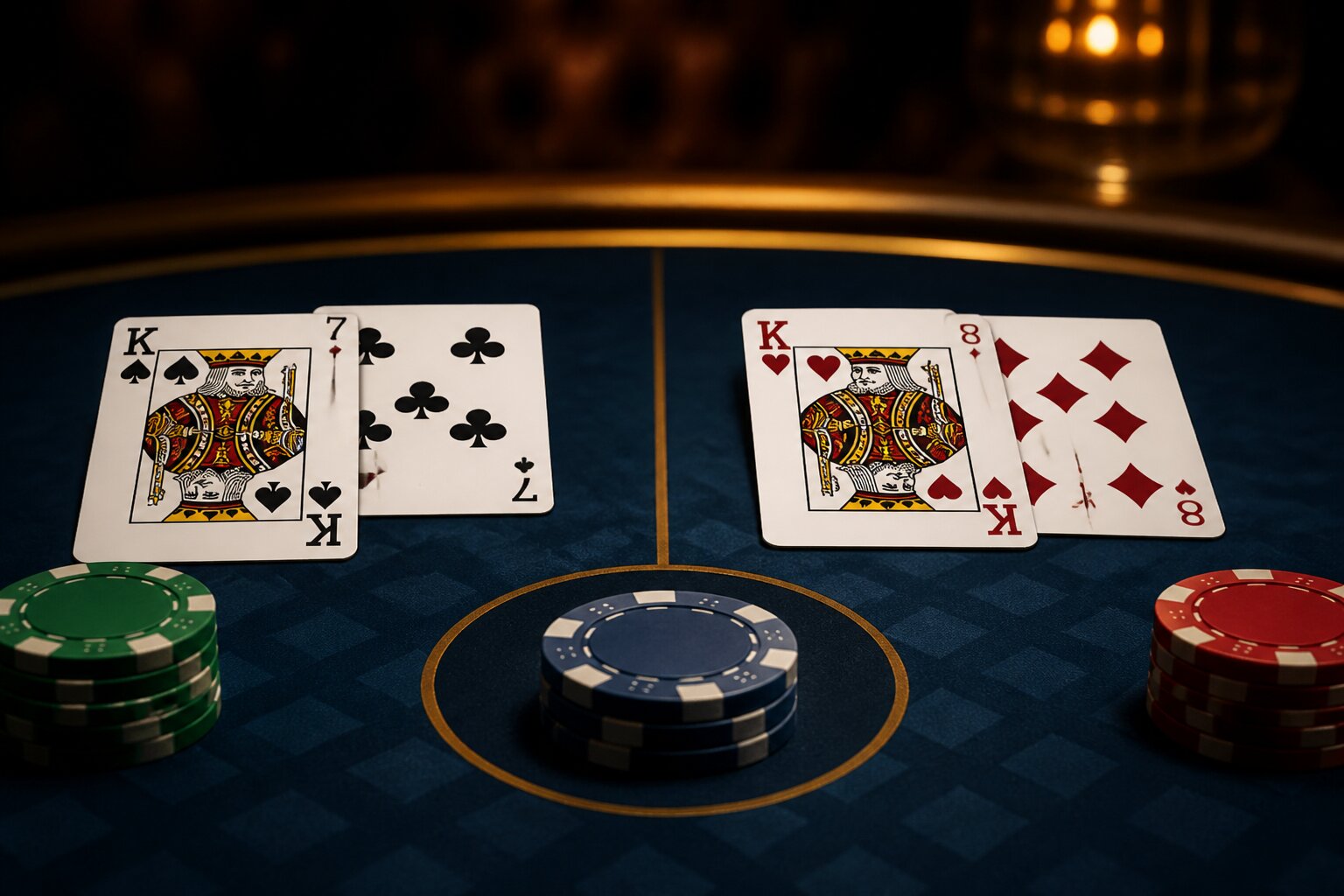
Baccarat is a simple card game built around a few clear choices and quick outcomes. Occasionally both the Player and Banker hands finish with the same total, and that result changes how bets are settled.
If you’ve ever watched a hand end level and wondered what follows, this article explains how ties are defined, how tie bets pay out, what happens to other wagers when a tie occurs, and how the odds influence whether a tie bet might suit your play. Read on for straightforward examples and the practical points to watch at the table.
What Is a Tie in Baccarat?
A tie happens when the Player and Banker hands end with identical totals after all cards are dealt and scored. Baccarat totals count only the last digit of any sum, so a hand worth 10 or 20 becomes 0, and a total of 15 becomes 5. For example, if the Player has a 7 and a 3 (total 10, scored as 0) and the Banker has two fives (total 10, scored as 0), the result is a tie.
Ties can occur with any matching total—0, 6, 8, and so on—and they are significantly less frequent than a Player or Banker win. That relative rarity is why casinos offer higher payouts for tie bets, and it also determines how other wagers are handled when a tie is declared. To see what this means for your money, read on to find out how tie bets are paid.
How Are Tie Bets Paid Out?
A tie bet is a distinct wager that both hands will finish equal. If that happens, the tie bet is settled as a winner and pays according to the table’s posted rate. The two most common rates you will encounter are 8:1 and 9:1. At 8:1, a £5 winning tie bet returns £40 plus the original £5 stake, making £45 in total. At 9:1, a £10 winning tie would return £90 plus the original £10, giving £100.
Always check the table’s payout before placing a tie bet, because different tables and operators may use different rates. The payout you see determines the mathematical advantage the game has over the player, which is important context when deciding whether to place a tie wager. Next, we’ll cover what happens to Player and Banker bets when the round ends level.
What Happens to Player and Banker Bets in a Tie?
When a tie occurs, wagers on the Player and on the Banker are treated as pushes. The stake is returned in full, and no win or loss is recorded for those bets. For example, a £10 bet on the Player returns your £10 if the result is a tie; the same applies to a Banker bet.
This push rule keeps outcomes fair for those main betting options while allowing the tie bet to be the only stake that resolves as a winner on a tie result. If you want to know how often tie results occur and whether the higher tie payouts justify the risk, the next section examines the frequency and statistical picture in more detail.
Are Tie Bets Worth Placing?
Tie bets pay more but occur less often, so the decision to place one depends on how you weigh risk against reward. Probability studies using a standard eight-deck shoe show ties happen in roughly 9.5% of hands. That low frequency is why the payout is higher than for Player or Banker wagers.
The game’s mathematical advantage, or house edge, on tie bets varies with the payout. At an 8:1 payout the house edge is around 14.4%, which means tie bets are substantially less favourable over time than the main bets. At 9:1 the edge drops to about 4.8%, making the bet more attractive than at 8:1 but still riskier than Player or Banker bets, which have edges near 1.24% and 1.06% respectively.
Because tie bets combine a low hit rate with a higher house edge at common payouts, many players treat them as occasional speculative wagers rather than a primary strategy. The next section looks closer at how frequently ties show up in play so you can judge the trade-off between rarity and payout.
How Frequently Do Ties Occur in Baccarat?
Ties are uncommon. Using probability calculations for an eight-deck shoe, ties are expected in about 68 hands out of every 800, which works out close to the 9.5% figure noted earlier. The remainder of hands split between Player and Banker results, with Banker wins slightly more likely than Player wins when the game rules impose the usual third-card drawing procedures.
In practice this means you might see a tie only once in every ten or eleven hands on average. The maths explains why casinos reward successful tie wagers more generously, and why those payouts must be checked before you play. With those frequencies in mind, the final section explains how different payouts affect the long-term chances of tie bets.
Understanding Payouts and House Edge
Tie payouts and house edge are two sides of the same coin: a higher payout compensates for rarity, but the house edge shows how that compensation compares to long-term expectation.
Typical tie payouts are 8:1 and sometimes 9:1. An 8:1 payout produces a house edge of about 14.4%, while a 9:1 payout lowers the edge to roughly 4.8%. The practical effect is that even when a tie bet wins, the frequency of wins and the payout combine to give a less favourable long-term return than the main Player and Banker options. Knowing both the payout and the implied house edge lets a player decide whether the bigger occasional returns of tie bets are worth the lower hit rate.
In short, tie bets can produce large single-round returns when they do occur, but their rarity and the typical house edge mean they are most commonly used as occasional, higher-risk plays rather than steady betting choices.
Play Online Casino Games at Free Spins No Deposit Casino
Ever fancy unwinding with some online casino fun in a place that's easy-going and welcoming? At our site, we're all about creating an enjoyable space for you to play and explore at your own pace.
**The information provided in this blog is intended for educational purposes and should not be construed as betting advice or a guarantee of success. Always gamble responsibly.