
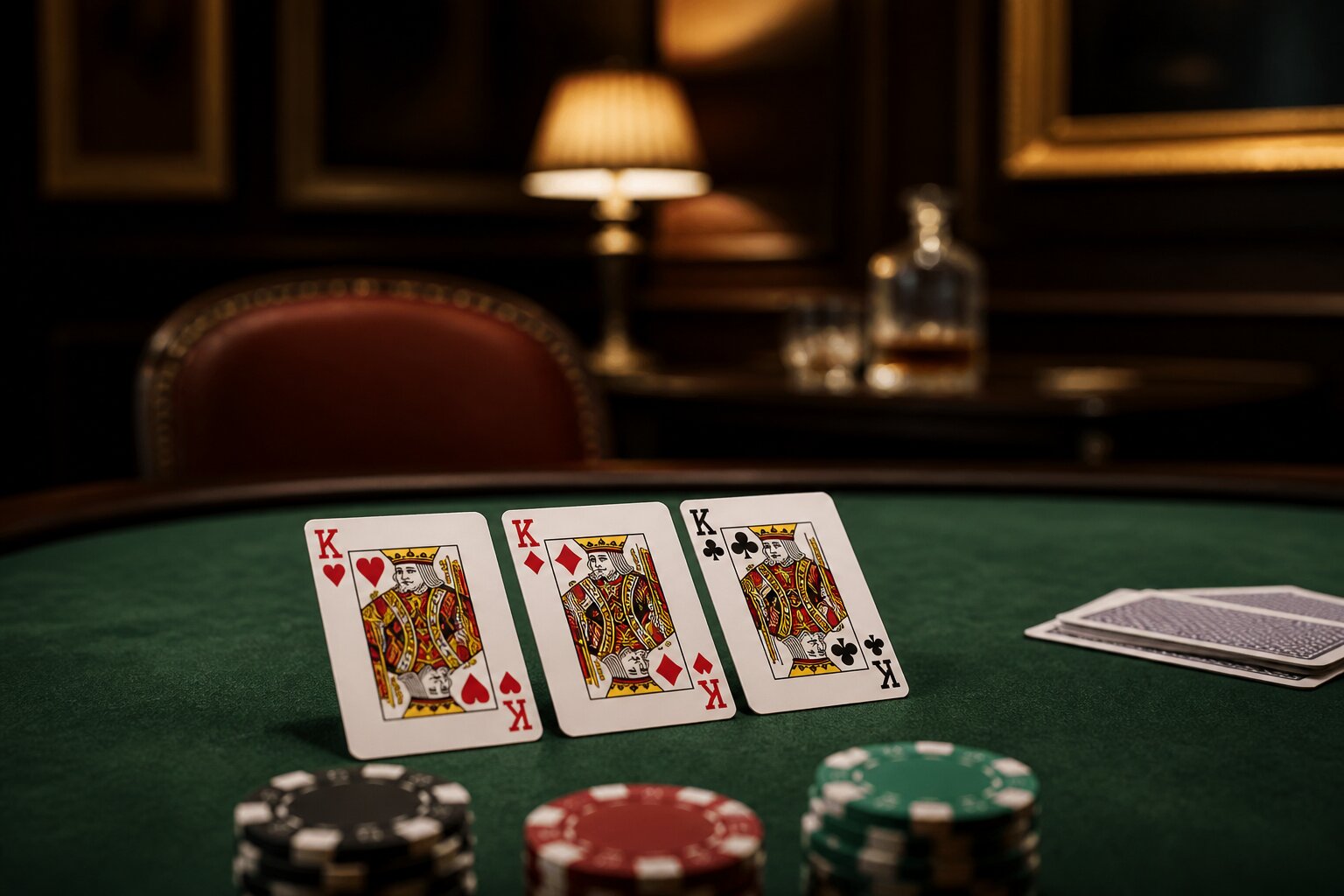
If you’re new to poker or brushing up your knowledge, understanding what a set is will sharpen your reading of the table. This term describes one of the clearer ways to make three of a kind, and recognising it helps with reading opponents and planning bets.
Many players conflate sets with similar hands, so this article explains the precise meaning, shows examples, and explores why a set is usually a strong holding. Read on for practical detail that will help you spot sets and use that knowledge at the table.
What Does ‘Set’ Mean in Poker?
A set occurs when you start a hand holding a pocket pair and a third card of the same rank appears among the community cards. In other words, two matching cards are in your private hand and the third is on the board, giving you three of a kind.
For example, if your hole cards are two fives and one of the shared cards is another five, you have a set of fives. The important point is that the pair originates in your hand rather than on the board.
This hidden pair element makes sets less visible to opponents than some other three-of-a-kind combinations, which affects how you might choose to bet.
How Is a Set Different From Three of a Kind?
The phrase three of a kind technically covers any hand with three cards of the same rank, but players distinguish between a set and what’s commonly called trips. The difference is in where the matching cards come from.
A set uses a pocket pair plus one community card. Trips arise when two matching cards are already on the board and you hold the third matching card in your hand. From a gameplay perspective, the visibility of trips—because two of the cards are on the board—often changes how opponents act, and that in turn affects your decisions.
Understanding this distinction helps when interpreting betting patterns and estimating how likely it is that somebody else can beat your hand.
What Is the Difference Between a Set and Trips in Poker?
Both terms describe three cards of the same rank, but they tend to present differently in play. A set is concealed by the fact that two matching cards are in your hand, while trips are more exposed because the board already shows two matching cards.
For instance, holding two jacks and seeing a jack on the board is a set. If two nines are on the board and you have the third nine, that is trips. Because sets are harder for opponents to detect, they often let you extract more value when you choose to bet.
Recognising which situation you’re in will influence how you balance aggression with caution.
How Do You Form a Set When Playing Poker?
Forming a set begins with being dealt a pocket pair as your hole cards. As the game progresses and community cards appear, one of those shared cards must match the rank of your pocket pair to complete the set.
This matching card can come at any stage: the flop, the turn, or the river. Each stage changes the context for betting: a set on the flop offers more opportunities to build the pot, while a set that arrives on the river provides less room for action but still improves your hand.
Because the set is part hidden and part board-dependent, its formation alters how opponents perceive the strength on display.
Why Is a Set Considered a Strong Hand in Poker?
A set ranks above pairs and two pairs in the hand hierarchy, which makes it a solid holding in many situations. Its concealed nature often means opponents underestimate it, so when you detect conditions that favour value-betting, a set can be a reliable source of pot-winning hands.
That said, a set’s strength depends on the overall board texture. If community cards allow for straights, flushes, or full houses, a set may be vulnerable. Reading the board and the likely hands opponents could hold is essential to judging when to press an advantage or step back.
A balanced approach—using the set’s hidden component to your benefit while staying aware of possible counter-combinations—tends to work best.
Common Scenarios Where Sets Win or Lose
Sets typically win when the board is relatively dry and does not present clear straight or flush possibilities. In those cases, a set outranks single pairs and two pairs that opponents might hold.
Conversely, a set can be overtaken when the community cards complete higher-ranking hands for other players, for example enabling a straight or flush, or when the board pairs and gives someone a full house. How opponents have bet on earlier streets often gives clues about these risks, and subtle shifts in their behaviour can indicate stronger combinations.
Keeping observation focused on both the board and betting patterns helps you judge whether a set is likely to hold up.
Frequently Asked Questions About Poker Sets
What is the difference between a set and three of a kind?
A set is formed when you start with a pocket pair and one matching community card appears. It is generally concealed because only you are certain you began with the pair.
Three of a kind, often called trips, occurs when two matching cards are on the board and you hold the third. In that case, the pair on the board makes the hand more visible to opponents.
The contrast is mainly about visibility and how opponents perceive the strength of your hand, which can affect betting and strategy.
Can a set ever be beaten in poker?
Yes. A set is a strong hand but it is not invulnerable.
Hands that can beat a set include:
- Straights
- Flushes
- Full houses
- Four of a kind
The final outcome depends on the community cards and the other players' holdings, so you should always consider the board texture and betting patterns before committing too many chips.
How rare is it to get a set in poker?
A set only happens when you start with a pocket pair and a matching card appears among the community cards. That specific sequence is less common than many single-card outcomes, but not so rare that sets are unheard of.
Pocket pairs themselves are a common starting point across many hands, so sets will appear regularly over time. Exact frequency varies with the number of players and the specific deal, but experienced players will see sets often enough to make them a meaningful part of strategy.
Do we encourage trying to play for sets?
Understanding the concept of sets is an important part of poker education and strategy.
However, it is unwise to play solely with the aim of making a specific hand. You should weigh the probability of hitting a set against the pot odds, position, opponents' tendencies, and your overall bankroll. Make decisions based on sound strategy rather than hoping for a particular outcome, and always stick to betting limits you are comfortable with.
Is there an age limit to play poker with us?
You must be at least 18 years old to play. We promote safe and controlled play and expect all users to follow the legal age requirements and our terms.
Myths and Misconceptions About Sets in Poker
Several myths about sets can lead to poor decisions if they go unchallenged. One is the idea that sets are unbeatable. While they are strong against many hands, they are still vulnerable when the board supports stronger combinations.
Another misconception is that experienced players can always spot a set. Because a set involves a hidden pair, it is often difficult for others to identify with certainty. That uncertainty is part of what makes sets valuable when used wisely.
There is also a tendency to assume you should always bet big with a set. In practice, the right action depends on the board, the opponents, and the size of the pot. Sometimes a controlled bet or even checking to induce action can be the better play.
Learning these nuances will help you make better choices at the table and get more from strong hands without overcommitting. Remember to manage your bankroll and play within limits; that keeps the game enjoyable and sustainable for everyone.
**The information provided in this blog is intended for educational purposes and should not be construed as betting advice or a guarantee of success. Always gamble responsibly.