
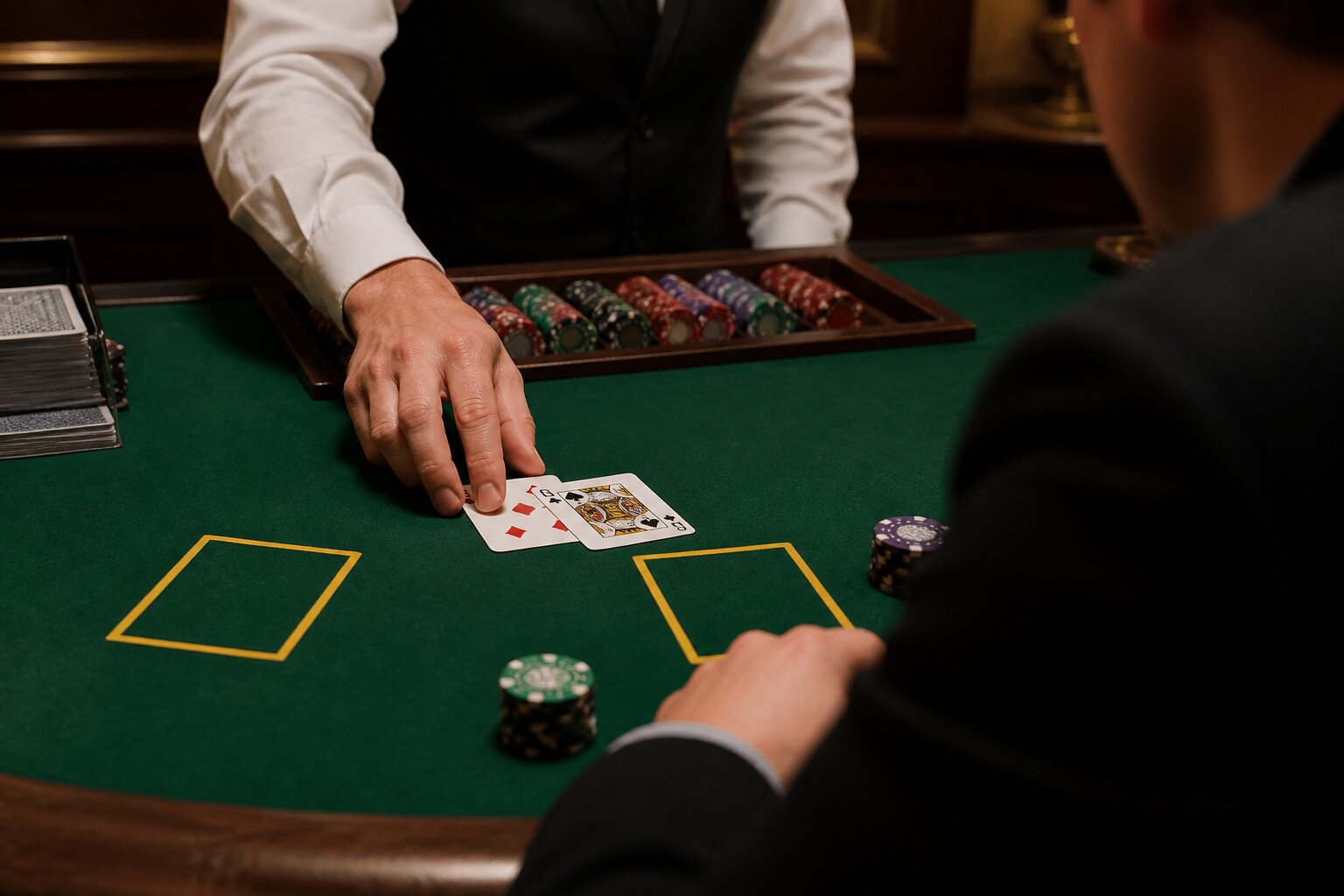
Ever sat at the blackjack table and heard someone shout, “Monkey!” after the cards are dealt? It can be a surprising moment if you’re not used to casino lingo.
Blackjack has its own colourful vocabulary that newcomers quickly notice, and learning a few terms helps the game feel less mysterious and more social.
Curious what “monkey” means and when people use it? Read on to learn the origins, typical use, and related slang so you can follow the conversation at the table with confidence.
Understanding 'Monkey' in Blackjack
In blackjack, “monkey” is a piece of slang for any card worth ten points — typically a jack, queen or king, and sometimes a ten itself. Players will call for a “monkey” when a ten-value card would improve their hand or change the outcome of the round, for example turning an eleven into twenty-one.
The shout is less about strategy and more about atmosphere: it signals a wish for a specific card while adding a bit of excitement around the deal. Saying “monkey” doesn’t change how the cards are dealt, but it is a quick, recognisable way to express the same idea across different players at the table. This kind of one-word shorthand is handy in the fast pace of live play and can make the table feel more connected.
If you want to know where this term comes from and how it spread across different casino cultures, the next section looks at its likely origins.
Where Does the 'Monkey' Slang Come From?
The exact origin of “monkey” in blackjack isn’t conclusively documented, but the most commonly cited explanation traces the word to East Asian gambling circles where similar slang for face cards and tens has been used. As casinos became international hubs, players from different backgrounds traded phrases and habits, allowing terms like “monkey” to travel beyond their original context.
This word stuck because it is short, easy to shout across a table and clearly understood by experienced players. Over time it entered casino glossaries and informal guides, helping cement it in the broader gambling lexicon. The term’s spread illustrates how social elements at tables — not the mechanics of the game — shape the language players use.
Next, we’ll look at why players keep using the term today and what it says about table culture.
Why Do Players Use the Term 'Monkey'?
Players use “monkey” mainly to express anticipation and to add energy to the round. It’s a shared cue that signals a desired outcome in a compact, familiar way. When several people echo the call, it creates a moment of collective attention that heightens the drama around the reveal of the next card.
Beyond atmosphere, the expression can also be habitual. Regular players adopt a set of phrases that help them interact quickly without interrupting the dealer’s flow. That said, the word is not linked to any change in strategy or odds; it is conversational rather than tactical. Table talk should always remain respectful, and keeping to light banter helps maintain a positive environment for everyone.
To make this clearer, the following section gives real examples of how “monkey” sounds in play.
Examples of 'Monkey' Used at the Blackjack Table
“Give me a monkey!”
“Come on, dealer, monkey card!”
“All I need is a monkey and I’m sorted.”
“Let’s see a monkey for the win.”
“Monkey, monkey, monkey—make it a ten!”
“Hope you pull a monkey this time.”
These short exclamations are commonly heard at live tables and capture the quick, informal nature of the term. They are playful calls often aimed at the dealer or the table, expressing a hope that a ten-valued card will appear to complete a favourable hand. At busy tables the phrase can be heard in rapid-fire, light-hearted exchanges between players and the dealer.
Although it is widely used in casual play, the term is slang rather than official terminology and should be understood as part of the gaming room’s informal language rather than a technical term. The next section lists related slang you’ll also hear around the felt.
Key Slang Terms Related to 'Monkey'
Face card: Refers to any jack, queen or king, all valued at ten in blackjack.
Paint: Another word for a face card, often used when hoping for a high-value draw.
Ten: A direct reference to any card with a value of ten, including the ten and face cards.
Blackjack (or “natural”): Being dealt an ace and a ten-value card as the first two cards, totalling twenty-one.
Bust: When a hand’s total exceeds twenty-one, resulting in an automatic loss for that round.
Hit: Requesting another card from the dealer to try and improve a hand.
Stand (or “stick”): Choosing not to take any more cards and keeping the current total.
These terms appear frequently at tables and knowing them will help you follow conversations and dealer prompts without hesitation. With that vocabulary in place, it’s useful to consider what knowing this slang actually does for a player’s experience.
How Does Knowing Slang Influence Your Game?
Recognising terms like “monkey” helps players feel at ease and more able to join table conversation, which in turn makes the game more engaging. It simplifies communication, reduces misunderstandings with dealers and other players, and lets newcomers observe the rhythm of a table more quickly.
It’s important to separate social language from the mechanics of the game. Outcomes in blackjack depend on the rules, card distribution and probability, not on words spoken during play. Familiarity with slang improves the social and practical side of playing, but not the mathematical chances of any hand.
Keep participation friendly and mindful of other players’ space; a considerate atmosphere makes the whole session more enjoyable. With a basic grasp of the terms and the table culture, you’ll be ready to listen, learn and join in the next time someone calls for a “monkey.”
Enjoy Casino Games at Free Spins No Deposit Casino
We welcome you to explore and enjoy casino games on our site, where you can play in a way that suits you best. Whether you are familiar with online casinos or just curious, you'll find a friendly environment with us.
**The information provided in this blog is intended for educational purposes and should not be construed as betting advice or a guarantee of success. Always gamble responsibly.