
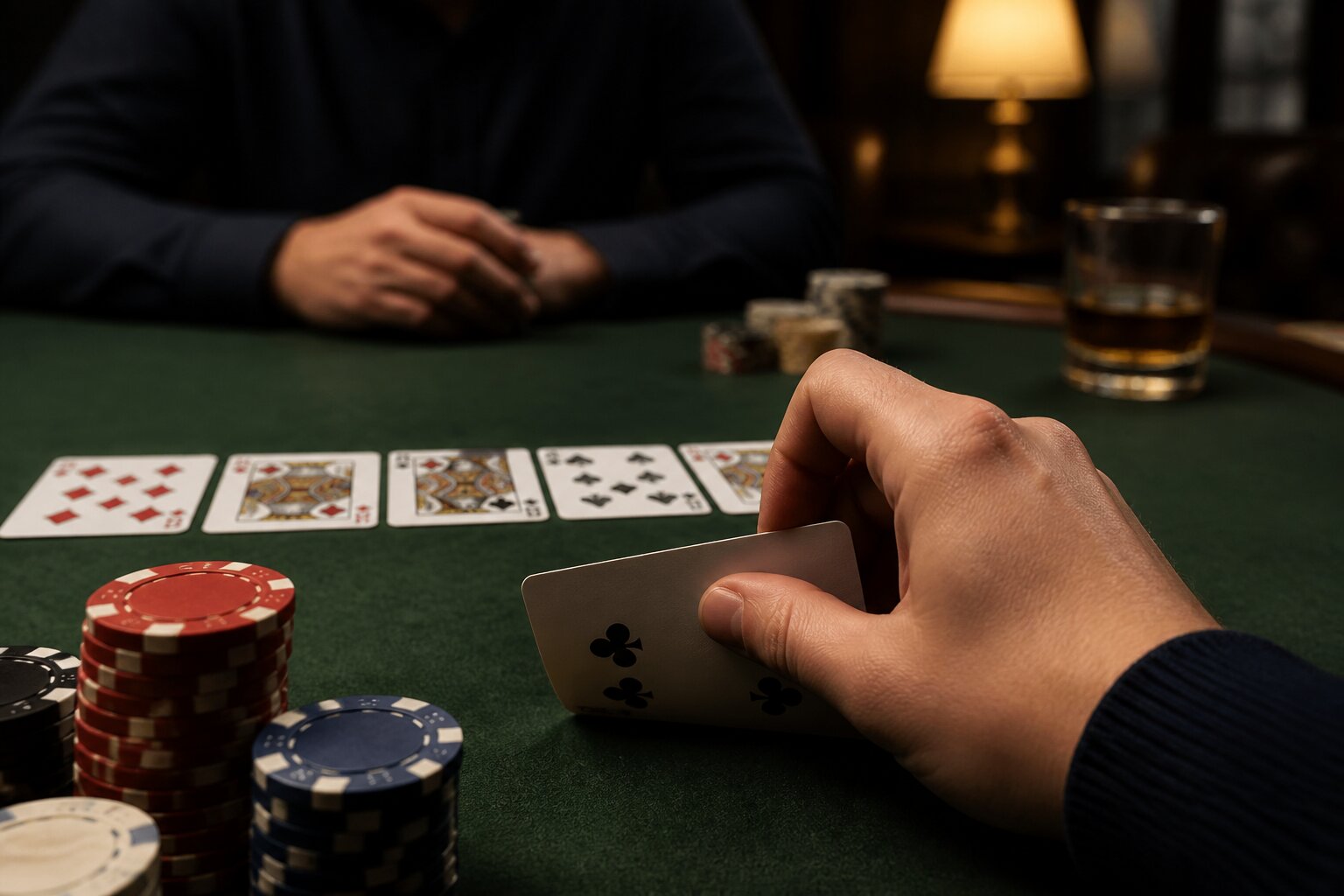
Ever been at a poker table and heard someone mention a "gutshot" and wondered what on earth they meant? You’re not alone — the term comes up a lot in Texas Hold’em and other community-card games. Some players chase these draws, others fold, but nearly everyone knows they can turn a hand on its head.
If you’re new to poker or want to sharpen your understanding, the gutshot straight draw is a key concept. It’s a situation that offers a clear path to improvement while also carrying a distinct set of odds and strategic considerations.
Curious about how a gutshot happens, how it compares with other draws, and when it might be worth pursuing? Read on for a complete, practical guide that keeps things clear and useful at the table.
What Is a Gutshot Straight Draw in Poker?
A gutshot straight draw, also called an inside straight draw, arises when you need one specific card value to complete a five-card straight and that card would fit in the middle of your sequence. The missing value sits between two of your cards, so only that one rank will finish the straight.
For example, if the five-card sequence you could make would be 5-6-7-8-9 but you currently have 5, 6, 8 and 9, only a 7 will complete it. Neither a 4 nor a 10 helps in this case. That single-rank requirement is what distinguishes a gutshot from other straight draws.
This type of draw can change the dynamic of a hand quickly. It isn’t a guarantee of improvement, but recognising it gives you another factor to weigh when deciding whether to call, fold or raise.
How Do You Identify a Gutshot Straight Draw?
Spotting a gutshot is largely visual: look for four cards that would form a straight if a single, specific rank appeared in the right place. The gap will be in the middle of the run — for instance, 2, 3, 5 and 6 need a 4 to make a straight.
During a hand, check the combinations formed by your hole cards and the community cards. Count how many different ranks could complete a sequence and whether those ranks sit inside the potential straight or at its ends. If only one rank completes the five-card sequence, you have a gutshot.
Identifying the draw is the first step. From there, you assess how much it costs to pursue and what other hand possibilities you might have at the same time.
Why Is It Called a Gutshot Draw?
The name comes from the way the missing card fits into the sequence: it is in the centre, as if there is a hole through the middle of the straight. Players adopted the vivid phrase to describe that feeling of waiting for a single, specific card to appear.
At the table it acts as a quick shorthand so people can communicate the situation without a long explanation. The term itself carries no technical meaning beyond indicating an inside straight draw, but it does signal a relatively narrow set of outs compared with other draws.
In most cases a gutshot gives you four outs (four cards of the rank you need), which is fewer than an open-ended straight draw that typically offers eight outs. Because the number of outs is smaller, the chance of completing a gutshot by the next card is lower than for many other draws, so it often affects how players size bets and choose whether to continue in a hand.
Keep in mind that actual odds can change with the number of players and the cards already visible, so assess each situation carefully and gamble responsibly.
Gutshot vs Open-Ended Straight Draw: What’s the Difference?
A gutshot requires one particular rank to complete the straight, while an open-ended straight draw can be finished by two different ranks, one at either end of the sequence. For example, 5-6-7-8 is open-ended because either a 4 or a 9 will make a straight. By contrast, 5-6-8-9 is a gutshot because only a 7 will work.
The practical consequence is that open-ended draws have roughly twice as many ways to hit as gutshots, which affects both the probability of improvement and how other players are likely to respond. Recognising which draw you face helps you judge whether the potential reward justifies continuing in the hand.
Common Misconceptions About Gutshot Draws
Many players overestimate how often a gutshot will hit. Because only one rank completes the straight, the chance is considerably smaller than with open-ended draws, and treating it as likely to come in can lead to poor decisions.
Another misconception is that chasing a gutshot is always reckless. While it is often a long shot, there are scenarios where a gutshot forms part of a stronger plan — for instance when you also have a pair, a backdoor flush draw, or favourable pot odds. The key point is that the draw should be evaluated in context rather than judged on its own.
Finally, gutshots are not secret or magical winning hands; they are simply one of many possible draws in poker. Understanding their real frequency and trade-offs will help you make clearer choices at the table.
Does the Gutshot Draw Often Win in Poker?
A gutshot does not complete frequently. After the flop in Texas Hold’em, with one card to come, there are typically 47 unseen cards and only four that will complete a gutshot (one per suit). That gives a probability of about 4/47, or just under 9%, for the turn. If you see both the turn and river, the combined chance to land the card by the river is around 16%.
Those numbers underline why gutshots are comparatively rare outcomes. They can pay off handsomely when they do hit, but most of the time they will not. Keeping these probabilities in mind helps you judge whether a call or raise is sensible in a given situation.
When Might a Gutshot Be Valuable in a Game?
A gutshot becomes more attractive when it is part of a larger set of possibilities. If the same holding also gives you a pair, a chance at a flush, or a way to bluff effectively, the overall value of the hand can justify continued action.
Situational factors matter too. Low-cost calls in multi-way pots can turn a modest gutshot into an acceptable gamble, because the pot odds may favour seeing an extra card. Conversely, facing heavy betting from a strong opponent reduces its worth, since even a completed straight might lose or be outdrawn.
Evaluating a gutshot means balancing the raw probability with what else the hand offers and how the betting is developing. That combined view will guide whether you press on or step back.
How to Calculate Gutshot Poker Odds
The calculation starts with counting your outs — the specific cards that will complete your straight. In a typical gutshot there are four outs. After the flop, subtract the visible cards from the full deck to find the number of unseen cards. With 47 unseen cards and 4 outs, your chance to hit on the next street is 4/47.
If you plan to see both remaining community cards, an approximate way to estimate the combined probability is to multiply your outs by four, giving roughly 16% for a 4-out gutshot across both streets. For exact numbers you can compute the complement probabilities, but the rough method is a quick, table-friendly shortcut.
Knowing these odds helps you compare the cost of calling to the value of the pot you might win, and that comparison is central to sensible decision-making at the table.
Final Thoughts on Gutshot Straight Draws
Understanding gutshot straight draws gives you clearer choices during a hand. They are distinctive because they rely on a single rank to complete a straight, which makes them less likely to land than open-ended draws. That rarity does not make them useless, but it does mean they should be treated as one piece of a larger strategic picture.
Think about the draw alongside your other holdings, the betting you face and the pot odds available. Make measured calls when the maths and the situation align, and fold when the cost outweighs the potential reward. If you ever feel unsure about your play, take a moment away from the table to reassess.
Enjoy the challenge of reading hands and balancing risk with reward, and remember there are support resources available if you need them. For information and help, visit BeGambleAware.org.
**The information provided in this blog is intended for educational purposes and should not be construed as betting advice or a guarantee of success. Always gamble responsibly.